

Automatic Temperature Monitoring for HACCP: Complete Guide
A fridge that drifts a few degrees overnight, on a Friday, with nobody checking again until Monday — that's the exact gap manual temperature logging can't close. Automatic temperature monitoring exists specifically for the hours nobody's watching.
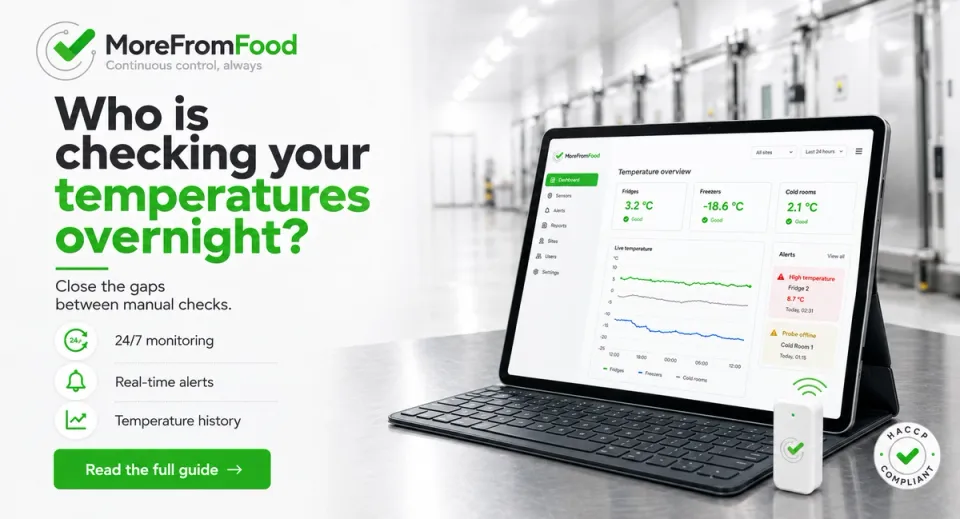
Automatic temperature monitoring uses wireless sensors placed in fridges, freezers, cold rooms and storage areas to record temperature readings continuously and send alerts the moment a reading moves outside a defined limit — without anyone taking a manual reading. Readings are stored centrally and linked to the relevant HACCP checklist, replacing handwritten logs with a searchable, timestamped digital record.
Key takeaways
- Automatic monitoring records temperatures continuously, including overnight and on weekends — periods manual checks structurally can't cover.
- The core setup is simple: wireless sensors in monitored areas, connected via Wi-Fi to a cloud platform, with alerts sent when limits are breached.
- Cooked food temperatures are typically handled separately, via a Bluetooth core thermometer that syncs a reading straight into the app.
- Existing temperature-logging equipment often doesn't need replacing — many systems can pull data from probes you already have.
- Installation is usually straightforward and can be done by the vendor's team, your own staff, or remotely, depending on setup.
In this article
- What is automatic temperature monitoring?
- How does it actually work?
- Where is it used?
- Manual vs. automatic: the short version
- How does this support HACCP compliance?
- What happens when a temperature goes out of range?
- Does it work with equipment you already have?
- How is a system installed?
- FAQ
What is automatic temperature monitoring?
Automatic temperature monitoring replaces a person walking to a fridge, reading a thermometer and writing the number down, with a wireless sensor that takes that reading on its own, continuously, and sends it straight to a central system. Instead of a snapshot taken once or twice a shift, you get a continuous record — and an alert the moment something moves outside the range you've defined.
How does it actually work?
The setup is more straightforward than it sounds. Stationary wireless sensors are installed in the areas you need to monitor — cold rooms, refrigerators, freezers — and communicate over Wi-Fi to a cloud platform, where readings are logged automatically and displayed on a dashboard in real time. For cooked food, a separate approach is typically used: a Bluetooth core thermometer takes the reading and syncs it directly into the app, avoiding a handwritten note that later needs typing up. Each reading — automatic or Bluetooth — gets linked to the relevant HACCP checklist, so there's no gap between "the check happened" and "the record exists."
Where is it used?
Wireless sensors are typically installed in refrigerators, freezers, cold rooms and general storage areas — anywhere a temperature excursion could compromise food safety. Some systems extend this to humidity monitoring in the same areas. Bluetooth core thermometers cover a different use case: verifying cooking, cooling or reheating temperatures at the point of preparation, rather than continuous storage monitoring.
Manual vs. automatic: the short version
Manual temperature logging only captures a reading at the exact moment someone checks it — anything that happens between checks (a door left open, a compressor failing overnight) can go unrecorded until product is already affected. Automatic monitoring closes that gap by recording continuously and alerting in real time, including outside working hours. We cover this comparison in full detail, including when manual logging is still perfectly adequate, in our dedicated article on manual vs. automatic temperature monitoring.
How does this support HACCP compliance?
Temperature control at critical control points is a core part of HACCP — Codex Alimentarius' HACCP principles require monitoring procedures at each CCP and documented corrective action whenever a critical limit is exceeded. EU food hygiene law goes further, requiring food business operators to maintain a permanent HACCP-based procedure (Regulation (EC) No 852/2004, Article 5) — a standard that's straightforward to demonstrate when every reading is automatically timestamped and stored, and much harder to prove consistently with handwritten logs covering only a fraction of the actual time period. Some industries have particularly hard temperature-based critical limits — pasteurization in dairy production and kill-step verification in meat processing are two clear examples where both time and temperature need to be captured together, not just one reading.
What happens when a temperature goes out of range?
The point of automatic monitoring isn't just recording — it's reacting faster. When a reading moves outside a defined limit, the responsible person or team gets a real-time alert, rather than discovering the problem at the next scheduled check. From there, the deviation and whatever corrective action follows can be logged directly against that event, creating a complete record: what happened, who was notified, what was done about it.
Does it work with equipment you already have?
Often, yes. Some systems, including MoreFromFood's, are built to pull data from cooling equipment that already records its own temperatures, so existing probes don't need to be replaced or duplicated — the existing data feed gets connected into the same platform used for alarms, analysis and non-conformance tracking, rather than requiring an entirely new sensor network from day one.
How is a system installed?
Installation is generally more straightforward than businesses expect. Based on how MoreFromFood implementations typically work: sensors can be installed by the vendor's own team on-site, or, particularly for larger companies with in-house technical staff, the customer's own team can be trained to set everything up. Where there's no local installation partner available, remote setup support is a common fallback. In all cases, the sensors connect to the cloud platform over Wi-Fi once installed, and monitoring starts immediately.
FAQ
Do I need to replace my existing fridge/freezer thermometers? Not necessarily. Many automatic monitoring systems can integrate with cooling equipment that already logs its own temperature data, rather than requiring you to install entirely new probes everywhere.
How is cooked food temperature handled, since it's not in a fixed location? Typically via a separate Bluetooth core thermometer, which takes the reading and syncs it directly into the app at the point of cooking, cooling or reheating, rather than through a stationary sensor.
What happens if the Wi-Fi goes down? This depends on the specific system's offline handling — worth confirming directly with your provider whether readings are cached locally and synced once connectivity returns, or whether monitoring pauses during an outage.
Can automatic temperature data be exported to other systems? Many platforms support exporting temperature data to BI or reporting tools, useful for combining food safety records with broader operational reporting.
Is automatic monitoring only useful for large, multi-site businesses? No — a single cold room or walk-in fridge benefits just as directly from continuous, unattended monitoring as a multi-site operation does. The case tends to get stronger as the number of monitored points grows, but it isn't exclusive to large operations.
Related reading
- How to Digitize HACCP: A Step-by-Step Guide
- Paper vs Excel vs Digital HACCP Software: Which Is Best?
- What Should HACCP Software Include? 15 Features to Compare
- What Makes Food Safety Records Audit-Ready? — temperature records need to pass the same test as any other HACCP record
- Temperature Monitoring (feature page)
See automatic temperature monitoring on your own sites
The clearest way to know what this looks like for your fridges, freezers and cold rooms specifically is to walk through it with us directly — every setup starts with that conversation, not a self-serve signup.
Book a demo or email info@morefromfood.com.
