

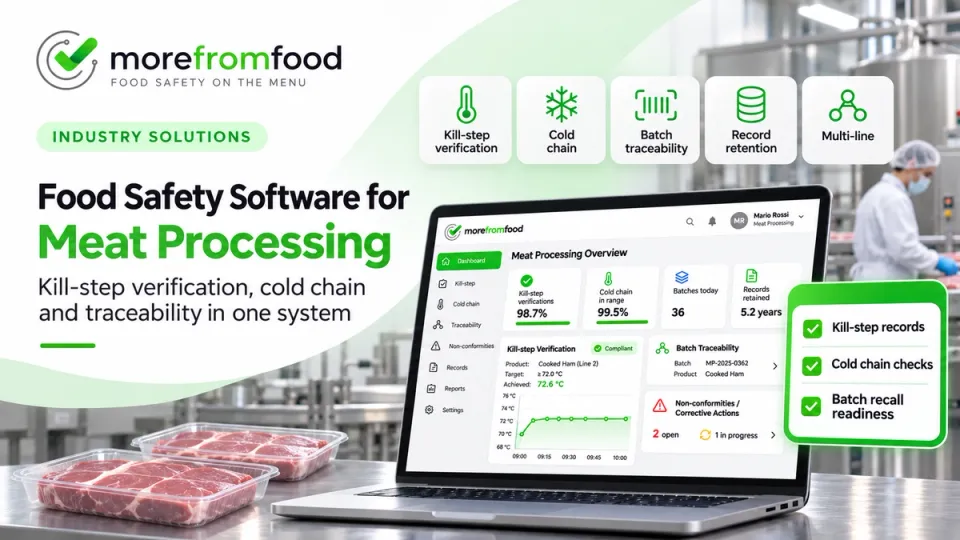
Food Safety Software for Meat Processing
Meat processing sits at the stricter end of food safety regulation for good reason: raw meat and poultry carry among the highest inherent pathogen risks in the food supply chain, and regulators reflect that with correspondingly detailed requirements — including, in some jurisdictions, specific minimum record retention periods written directly into law.
Food safety software for meat processing needs to handle a few things with particular rigor: kill-step verification (cooking, curing or other lethality steps), an unbroken cold chain from receiving through processing and dispatch, and traceability precise enough to support a fast, narrow recall if needed. The same digital HACCP platform used across food production generally handles this — the configuration simply reflects meat processing's stricter baseline.
Key takeaways
- Meat and poultry processing often has specific regulatory retention requirements (for example, US 9 CFR 417.5 sets minimums by product type) that take precedence over general record-keeping rules of thumb.
- Kill-step verification — confirming a lethality step actually reached its required parameters — is typically the single most scrutinized control point.
- Cold chain integrity matters at every stage: receiving, chilling, processing, packaging and dispatch, without gaps.
- Batch and lot traceability needs to be precise enough to isolate a specific production run, not just a general date range, given how quickly meat products move through distribution.
- Multi-shift, multi-line processing plants benefit particularly from centralized, consistent digital checklists across all lines.
In this article
- Why does meat processing carry stricter requirements?
- Kill-step verification as a control point
- Cold chain from receiving to dispatch
- Record retention specifics
- Traceability precision for fast recalls
- FAQ
Why does meat processing carry stricter requirements?
Raw meat and poultry are recognized as higher-risk products across most food safety frameworks, which is reflected in more prescriptive regulatory requirements than many other food categories — including, in some jurisdictions, specific mandated minimums for record retention rather than general guidance. This higher baseline of scrutiny is exactly why consistent, precise digital records matter more here than in lower-risk categories.
Kill-step verification as a control point
Wherever a processing step is specifically designed to reduce pathogens — cooking, curing, smoking — verifying that step actually achieved its required time/temperature or other parameters is typically the most heavily audited control point in the entire process. Digital monitoring here works the same way as pasteurization verification in dairy: capturing the actual parameters achieved for each batch, not just confirming the step happened, and flagging automatically when a batch doesn't meet the defined limit.
Cold chain from receiving to dispatch
Meat processing's cold chain needs to be unbroken from the moment product arrives through chilling, processing, packaging and dispatch — any gap is a genuine risk point, not just a documentation issue. We cover the general principles of end-to-end cold chain monitoring in our cold chain guide; the meat-specific consideration is simply that the tolerance for gaps is lower given the product's inherent risk profile.
Record retention specifics
Where general food safety guidance often points to a "shelf life plus one year" rule of thumb, meat and poultry processing in some jurisdictions has specific mandated minimums instead — in the US, for example, 9 CFR 417.5 requires at least one year of retention for refrigerated product records and at least two years for frozen or shelf-stable products, with records required on-site for the first six months. We cover this in more general detail in How Long Should HACCP Records Be Kept? — for meat processing specifically, confirm the exact regulatory minimum for your jurisdiction and product category rather than relying on the general guideline alone.
Traceability precision for fast recalls
Because meat products often move through distribution quickly, traceability precision matters more here than in categories with longer shelf lives and slower distribution. Batch-level tracking needs to be specific enough to isolate a particular production run or shift, not just a general date range — the difference between those two levels of precision is often the difference between a narrow, targeted recall and a much broader, more costly one.
FAQ
Does meat processing require different software than other manufacturing? Not necessarily different software, but the configuration needs to reflect stricter defaults — tighter cold chain tolerances, mandatory kill-step verification, and jurisdiction-specific retention minimums.
What's the most commonly audited control point in meat processing specifically? Kill-step verification — confirming that a cooking, curing or other lethality step actually achieved its required parameters for each batch, not just that the step was performed.
How precise does batch traceability need to be? Precise enough to isolate a specific production run or shift, given how quickly meat products typically move through distribution — a general date-range level of traceability is usually not precise enough for a fast, narrow recall.
Are record retention rules the same everywhere for meat processing? No — some jurisdictions have specific mandated minimums (like the US's 9 CFR 417.5) that differ from general food safety record-keeping guidance. Always confirm the specific requirement for your product category and jurisdiction.
Related reading
- Automatic Temperature Monitoring for HACCP: Complete Guide
- How Long Should HACCP Records Be Kept?
- How Digital Records Improve Recall Readiness
See MoreFromFood configured for meat processing
Walk through your kill-step verification, cold chain and retention requirements with us directly.
Book a demo or email info@morefromfood.com.
