

Manual vs Automatic Temperature Monitoring: Which Do You Need?
Every food business monitors temperature in some form — the question is whether a person does it, a sensor does it, or some mix of both. That choice affects more than convenience: it changes what your records can actually prove, and what gaps exist in your coverage without you realizing it.
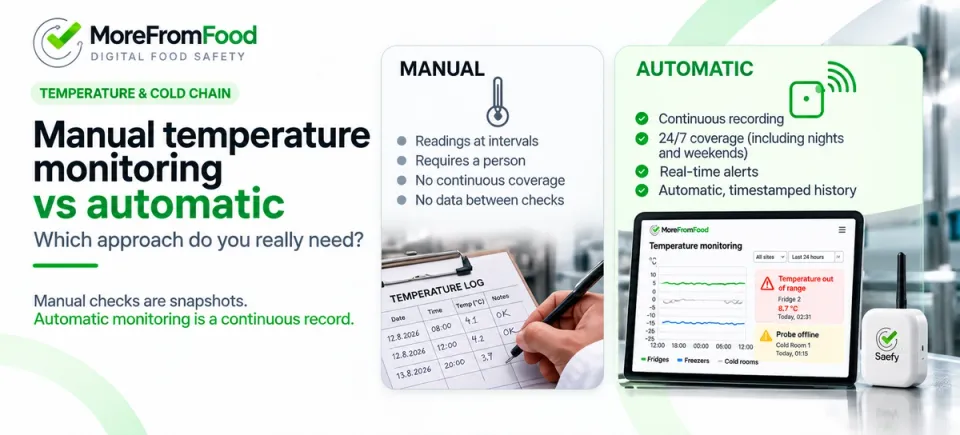
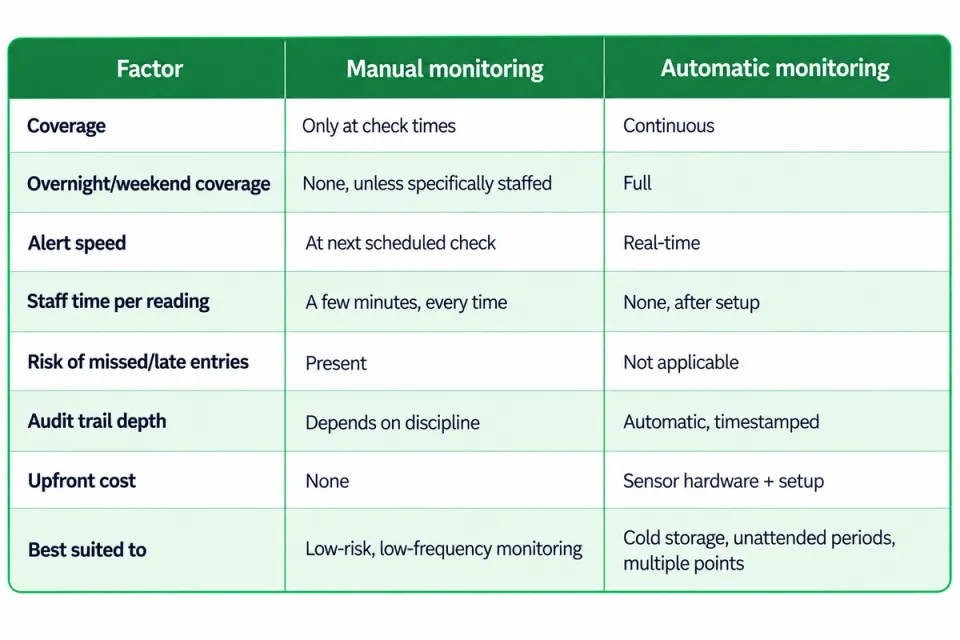
Manual temperature monitoring means a person takes and records a reading at scheduled intervals; automatic monitoring uses wireless sensors that record continuously and alert in real time when a reading goes out of range. Manual monitoring can be entirely adequate for simple, low-risk operations with infrequent checks. Automatic monitoring earns its cost once continuous coverage, multiple monitored points, or unattended hours (nights, weekends) start to matter.
Key takeaways
- Manual monitoring only captures a reading at the moment someone checks it — anything between checks goes unrecorded.
- Automatic monitoring records continuously, including outside working hours, and alerts in real time rather than at the next scheduled check.
- Manual logging can still be entirely appropriate for a small operation with few monitored points and low risk.
- The two aren't mutually exclusive — most real-world setups use automatic sensors for storage (fridges, freezers, cold rooms) and manual or Bluetooth-based checks for point-in-time readings like cooking temperatures.
- The clearest sign it's time to move from manual to automatic is needing to know what happened overnight or over a weekend, not just during staffed hours.
In this article
- What's the actual difference?
- Comparison at a glance
- When is manual monitoring still enough?
- When does manual monitoring start to fail?
- What does automatic monitoring add?
- Do you have to choose one or the other?
- How much staff time does manual logging actually take?
- FAQ
What's the actual difference?
Manual temperature monitoring means someone physically checks a thermometer and writes down or types in the reading, at whatever frequency your HACCP plan requires — often a few times per shift. Automatic monitoring replaces that walk-and-check with a wireless sensor that takes readings continuously (commonly every few minutes) and sends them straight to a central system, without anyone needing to be present. The practical difference isn't just "less manual work" — it's coverage. Manual checks are a series of snapshots; automatic monitoring is a continuous record.
Comparison at a glance
When is manual monitoring still enough?
Genuinely, for some operations it is. A very small kitchen with one or two fridges, checked a few times a day by staff who are consistently present, can operate adequately on manual logging — provided the checks are actually completed on schedule and the records are legible and retrievable. The risk with manual monitoring isn't that it's inherently unreliable; it's that it depends entirely on someone doing it correctly, every time, including on a busy or short-staffed day — which is exactly the kind of time pressure restaurant kitchens deal with during service.
When does manual monitoring start to fail?
The gap shows up specifically outside staffed hours. A compressor failing at 11pm on a Friday, in a cold room nobody checks again until Monday morning, is invisible to manual monitoring by design — not because anyone did something wrong, but because manual checks simply can't happen when no one is there to do them. The same gap applies, at smaller scale, to any period between scheduled checks: a door left ajar for twenty minutes between rounds leaves no trace on paper.
What does automatic monitoring add?
Two things manual monitoring structurally can't provide: continuous coverage (including unattended hours) and real-time alerting. Rather than discovering a deviation at the next scheduled check — potentially hours after it started — a responsible person is notified the moment a reading moves outside the defined range, which is often the difference between a quick fix and a batch of spoiled product.
Do you have to choose one or the other?
No — and in practice, most operations end up using both, applied to different situations. Automatic sensors are typically used for storage areas that need continuous coverage: fridges, freezers, cold rooms. Manual or Bluetooth-based checks remain common for point-in-time readings that don't fit a fixed sensor, like verifying a cooked or reheated food has reached a safe core temperature at that specific moment. A Bluetooth core thermometer bridges the two — still a manual action, but the reading syncs directly into the system rather than being written down and typed up later.
How much staff time does manual logging actually take?
Individually, a single manual check takes just a couple of minutes — which is exactly why the cumulative cost is so easy to underestimate. Multiply that by every check, every location, every day, and the time adds up to a meaningful amount over a year, even before counting time spent correcting entries or searching for a specific past record. For a fuller breakdown of what this actually adds up to, see our Digital HACCP ROI article and cost calculator.
FAQ
Is automatic monitoring required by law? No. EU food hygiene law requires a permanent, documented HACCP-based procedure, but doesn't mandate a specific method — manual monitoring can satisfy the requirement if it's done consistently and the records are retrievable.
Can I add automatic monitoring to only some locations, like walk-in coolers? Yes. It's common to start with the highest-risk or highest-value storage areas — walk-in coolers, freezers — and expand coverage from there rather than instrumenting every point at once.
Does automatic monitoring replace the need for any manual checks? Not entirely. Point-in-time checks like cooked food core temperature still typically involve a person taking the reading, even if it's recorded via a Bluetooth thermometer rather than written down.
What's the biggest risk of staying fully manual? The biggest risk isn't day-to-day accuracy, it's the unattended-hours gap — problems that develop when no one is scheduled to check, which by definition manual monitoring can't catch until the next round.
Related reading
- Automatic Temperature Monitoring for HACCP: Complete Guide
- Digital HACCP ROI: How Much Is Paper Really Costing You?
- Paper vs Excel vs Digital HACCP Software: Which Is Best?
- Digital HACCP for Hotels — a different context for the manual/automatic decision, across several food service points at once
- Temperature Monitoring (feature page)
See both approaches in one system
MoreFromFood supports manual entry, Bluetooth core temperature checks and fully automatic sensor monitoring in the same platform, so you can mix approaches by location rather than committing to one method everywhere.
Book a demo or email info@morefromfood.com.
