

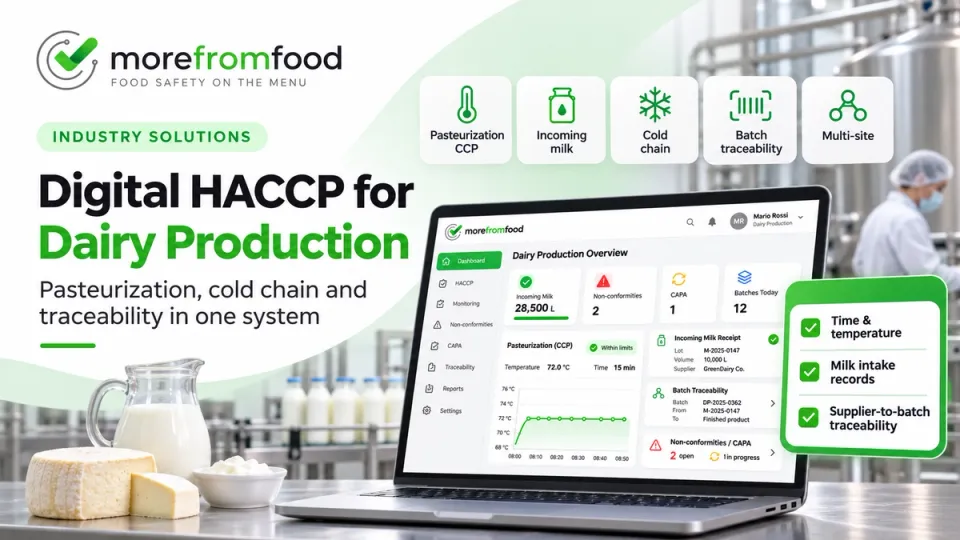
Digital HACCP for Dairy Production
Dairy has a few things going for it that make HACCP genuinely different from, say, a bakery: a hard temperature-driven critical limit at pasteurization, a cold chain that starts before the product even reaches your plant, and a product category where a single contamination event can affect an unusually large batch fast.
Digital HACCP for dairy production means the same core system — checklists, temperature monitoring, non-conformance tracking, traceability — configured around dairy-specific control points: pasteurization time/temperature, incoming milk quality and cold chain, and batch-level traceability from farm intake through to finished product. MoreFromFood already supports dairy, bakery, meat and vegetable production sites within the same platform, rather than requiring a separate dairy-specific product.
Key takeaways
- Pasteurization is dairy's clearest hard critical limit — time and temperature both matter, and both need to be recorded, not just one.
- Cold chain monitoring needs to start at incoming milk receipt, not just inside your own storage and production areas.
- Batch traceability is especially important in dairy, since raw milk from multiple sources is often blended before processing.
- The same digital HACCP platform used for other production types can be configured for dairy-specific control points — it doesn't require dairy-specific software.
- Multi-site dairy operations (multiple collection points or processing facilities) benefit particularly from centralized oversight across locations.
In this article
- What makes dairy HACCP different?
- Pasteurization as a critical control point
- Cold chain from farm to plant
- Traceability with blended raw material
- FAQ
What makes dairy HACCP different?
Most of dairy's HACCP-specific demands trace back to two things: a genuine kill-step (pasteurization) with hard time/temperature parameters, and a product that starts as a highly perishable raw material collected from potentially multiple external sources before it ever reaches your control. This is different from, say, a bakery, where the core risks are more about ingredient handling and allergen cross-contact than a single hard thermal critical limit.
Pasteurization as a critical control point
Pasteurization is the clearest example of a true critical control point in dairy: specific time and temperature combinations that must be met, with monitoring and documented corrective action required whenever a batch doesn't meet them. Digitally, this means capturing both time and temperature together for each batch — not just a single reading — and flagging automatically if either falls outside the defined limit, rather than relying on someone reviewing a printed chart after the fact.
Cold chain from farm to plant
Dairy's cold chain starts before the product reaches your facility. Incoming raw milk temperature at receipt is itself a control point, and from there, the same continuous monitoring principles covered in our cold chain guide apply throughout storage and processing. The main dairy-specific addition is that receipt itself needs to be treated as seriously as internal storage, since temperature abuse before the product arrives can't be corrected later.
Traceability with blended raw material
Dairy processing often blends raw milk from multiple farms or collection points before pasteurization, which makes traceability more complex than a simple one-batch-in, one-batch-out model. A traceability system needs to record which incoming milk lots contributed to which processed batch, so that if an issue is later traced to a specific supplier, you can identify exactly which finished batches are affected — we cover this kind of many-to-many batch tracking in more detail in How Digital Traceability Works in Food Manufacturing.
FAQ
Does dairy production need different software than other food manufacturing? Not necessarily — the same digital HACCP platform can be configured around dairy-specific control points (pasteurization, incoming milk temperature) rather than requiring dedicated dairy-only software.
What standards are most relevant for dairy producers specifically? This depends on your market, but HACCP, ISO 22000, IFS and BRCGS all apply to dairy processing — see our comparison in IFS vs BRCGS vs FSSC 22000 for the differences between them.
How is pasteurization monitoring typically automated? Through sensors that capture both temperature and time together at the pasteurization point, rather than a manual spot-check, so a batch that doesn't meet the defined combination is flagged automatically.
Does traceability need to go back to individual farms? Generally yes, at least to the collection point or supplier level — this is what allows a contamination issue traced to a specific source to be matched against exactly which processed batches it affected.
Related reading
- Automatic Temperature Monitoring for HACCP: Complete Guide
- How Digital Traceability Works in Food Manufacturing
- Best HACCP Software for Food Manufacturing in 2026
See MoreFromFood configured for dairy production
Walk through your actual pasteurization, cold chain and traceability requirements with us directly.
Book a demo or email info@morefromfood.com.
