

What Should HACCP Software Include? 15 Features to Compare
Most HACCP software demos look impressive — clean dashboards, mobile apps, a confident sales pitch. What's harder to see in a 30-minute call is whether the platform actually covers what your operation needs once you're using it daily, across every site, at 6am and during an audit. This checklist is meant to be used before that call, not during it.
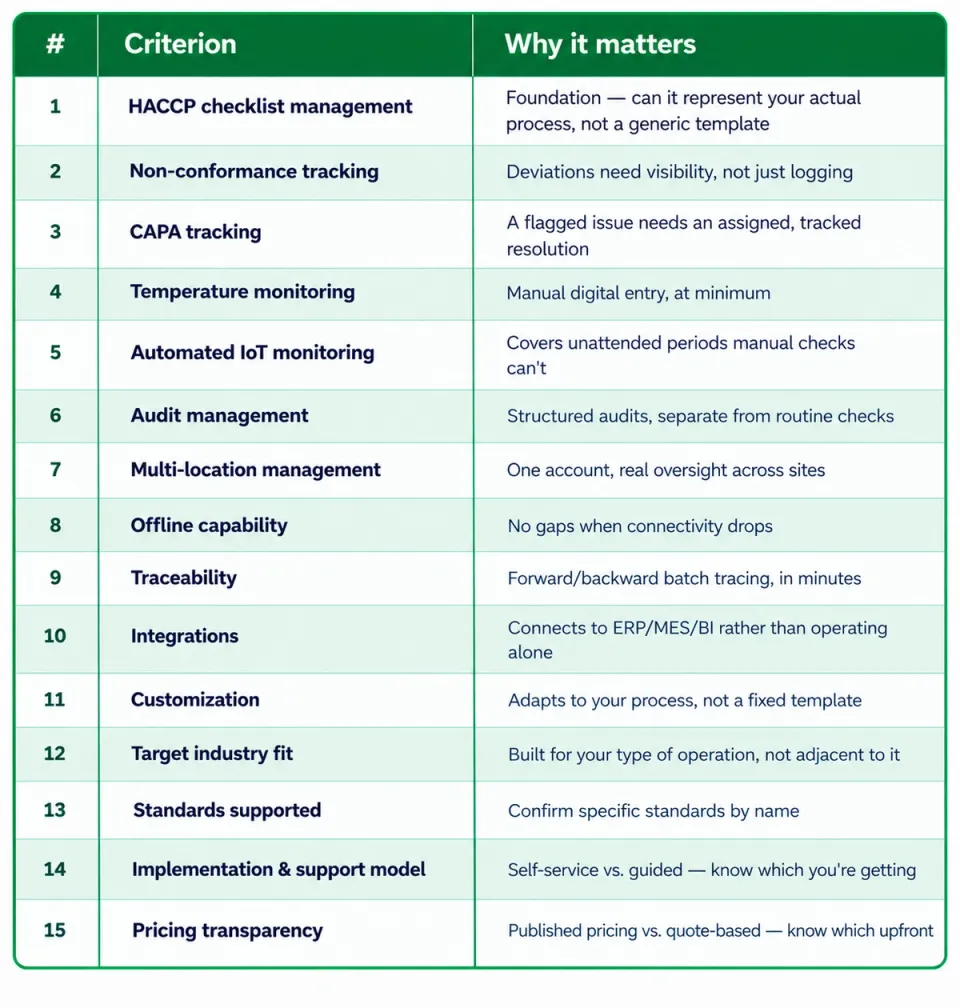
HACCP software should be evaluated across 15 criteria grouped into five areas: core food safety functionality, monitoring, scale and reliability, fit and flexibility, and buying practicalities. Not every criterion matters equally for every business — a single-site restaurant and a multi-site manufacturer will weight this list differently — but knowing all 15 exist means you're less likely to discover a gap after you've already signed.
Key takeaways
- The 15 criteria below fall into 5 groups: core functionality, monitoring, scale and reliability, fit and flexibility, and buying practicalities.
- Not all 15 matter equally to every business — which ones matter most depends on your size, number of sites and industry.
- Multi-site management, offline capability and automatic temperature monitoring are the criteria that most often get underestimated until after go-live.
- Pricing transparency and implementation model (self-service vs. guided) say as much about a vendor's target customer as their feature list does.
- Use this list to structure vendor demos and RFPs — asking about a criterion directly gets a clearer answer than waiting to see if it comes up.
In this article
- Core food safety functionality
- Monitoring
- Scale and reliability
- Fit and flexibility
- Buying practicalities
- The full checklist at a glance
- How to weight this list for your business
- FAQ
Core food safety functionality
1. HACCP checklist management The foundation: can the platform represent your actual hazard analysis, CCPs and critical limits as digital checklists, or does it force your process into a generic template? Ask to see your own type of check built in the system, not just a demo example.
2. Non-conformance tracking When a check fails or a limit is exceeded, does the system flag it as a distinct event, or does it just sit in the log alongside every passed check? Non-conformances need to be visible on their own, not buried in routine data.
3. Corrective and preventive action (CAPA) tracking A flagged deviation is only useful if something happens next. Look for the ability to assign a corrective action to a specific person, with a deadline, and a record of how and when it was resolved — not just a comment field.
Monitoring
4. Temperature monitoring At minimum, the system should support digital entry of temperature readings. Ask specifically how readings are captured, verified and flagged when out of range.
5. Automated IoT monitoring A step beyond manual digital entry: wireless sensors that log temperatures automatically, without a person taking a reading. This matters most for unattended periods — overnight, weekends — when manual checks simply can't happen.
6. Audit management Beyond day-to-day checks, does the platform support structured internal or external audits — checklists specific to IFS, BRCGS or your own internal standard, with findings tracked separately from routine checks? See our full breakdown of what digital audit management should handle that a spreadsheet typically can't.
Scale and reliability
7. Multi-location management Can one account genuinely oversee multiple sites — comparing performance across locations, applying updates centrally — or does each site effectively run as a separate silo? This is one of the most commonly underestimated criteria for growing businesses.
8. Offline capability What happens when a site loses internet connectivity — a common reality in cold rooms, basements or rural locations? A platform that can't record checks offline creates exactly the kind of gap digitalization is meant to remove.
9. Traceability Can the system trace a batch or ingredient forward and backward through your process, and how quickly? In a genuine recall situation, this needs to take minutes, not require someone piecing together multiple records. See what traceability software actually needs to do for more on this specific capability.
Fit and flexibility
10. Integrations Does the platform connect to systems you already use — ERP, MES, BI/reporting tools — or does it operate as an island that requires manual data transfer in and out?
11. Customization Can workflows, forms and roles be adapted to your specific process, or are you limited to a fixed template? This matters far more for complex, multi-site operations than for a single simple kitchen.
12. Target industry fit Some platforms are built around restaurants and catering; others around food production and manufacturing. A platform built for one doesn't always translate cleanly to the other — ask what industries the vendor's existing customers actually operate in, not just what the software theoretically supports.
Buying practicalities
13. Standards supported Which standards does the platform explicitly support — HACCP, ISO 22000, IFS, BRCGS, FSSC 22000, other GFSI-recognized schemes? If you need to demonstrate compliance against a specific standard, confirm it by name rather than assuming "food safety compliant" covers it.
14. Implementation and support model Some platforms are built for fast, largely self-service setup. Others use guided implementation, where a team helps configure the system around your existing HACCP plan before go-live. Neither is inherently better — but they suit different levels of operational complexity, and it's worth knowing which one you're signing up for.
15. Pricing transparency Some vendors publish pricing; most in this space quote based on sites, users and modules. Neither approach is a red flag on its own, but it's worth knowing upfront whether you're looking at a self-serve price list or a sales-scoped quote, since that affects how quickly you can compare options.
The full checklist at a glance
How to weight this list for your business
Not every business needs all 15 at full strength. As a rough guide:
- Single-site restaurant or small kitchen — prioritize #1, #4, #14 (fast setup) and #15 (clear pricing); #7, #10 and #11 matter much less at this scale.
- Multi-site restaurant or hotel group — #7 (multi-location), #6 (audits) and #12 (industry fit) become far more important.
- Multi-site food production or manufacturing — all of #7 through #11 matter, since these operations tend to need genuine customization, integrations and centralized oversight, not just centralized checklists.
For a deeper look at how five specific platforms actually score against these criteria, see Best HACCP Software in 2026: 5 Digital HACCP Systems Compared.
FAQ
Is HACCP software the same as food safety management software? Not exactly. HACCP software focuses specifically on hazard analysis, critical control points and their monitoring. Broader food safety management software often adds supplier management, document control and quality management on top of the HACCP core — worth checking which scope a given platform actually covers.
Do I need automated IoT temperature sensors from day one? Not necessarily. Many businesses start with manual digital entry and add automated sensors later, once checklists are running smoothly. It's a reasonable phased approach rather than an all-or-nothing decision.
How important is offline capability really? It depends on your sites. A modern office kitchen with reliable wifi may rarely notice its absence; a cold storage facility or rural production site can lose real records every time connectivity drops without it.
What questions should I ask a HACCP software vendor during a demo? Go through this list directly: ask to see your own type of check built live, ask how multi-site oversight actually works (not just that it exists), ask what happens offline, and ask which standards are explicitly supported by name.
Does a small business need all 15 criteria? No — see the weighting guidance above. The point of the full list isn't that every item is mandatory, but that you decide deliberately which ones matter for your situation, rather than discovering a gap after implementation.
Related reading
- Best HACCP Software in 2026: 5 Digital HACCP Systems Compared
- How to Digitize HACCP: A Step-by-Step Guide
- Paper vs Excel vs Digital HACCP Software: Which Is Best?
- Digital HACCP ROI: How Much Is Paper Really Costing You?
- Audit Management
See how MoreFromFood scores against this checklist
Rather than take our word for it, walk through your own checklist against MoreFromFood directly — every setup starts with a conversation about your actual HACCP plan and sites, not a self-serve signup.
Book a demo or email info@morefromfood.com.
