


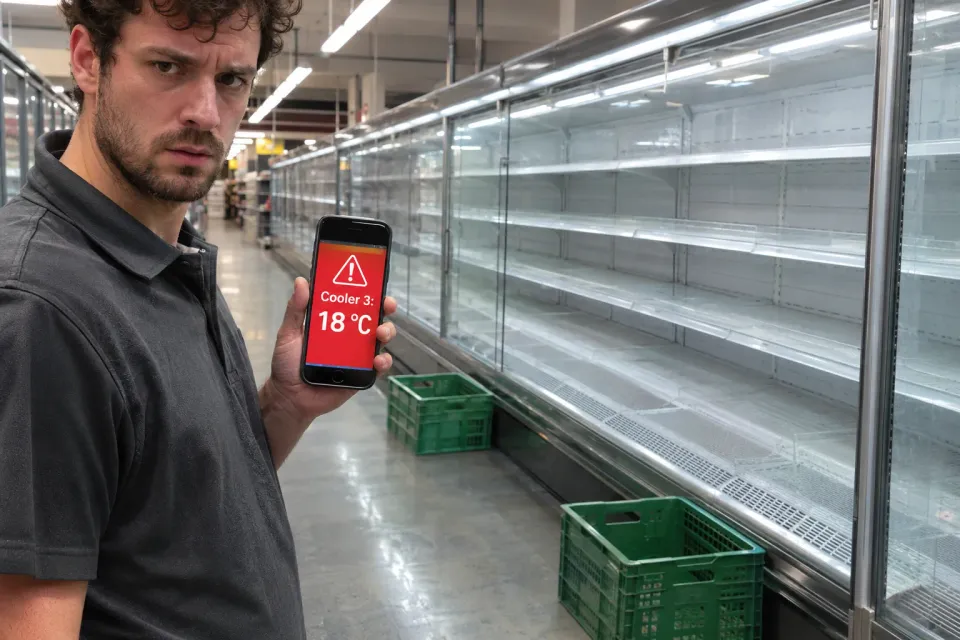
On the night of 12 October 2026, hackers heated up the fridges in hundreds of French supermarkets. On 2 November, the same attack hit stores in eight European countries, from Sweden to Ireland. In one Swedish store, a freezer warmed up to 50 °C.
The damage is huge. A Delhaize store in Hoeilaart, Belgium, had to throw away €100,000 worth of food. The CEO of Intermarché estimated losses at tens of millions of euros in a single day, and Coopérative U estimates that losses at a larger store could exceed €200,000.
Key takeaways
- The attackers broke into internet-facing refrigeration controllers and extended the defrost cycles.
- The alarm was part of the same system they attacked, so it only went off hours later.
- Protection has two parts: take the controllers off the public internet and add independent temperature monitoring.
- Independent monitoring equipment costs a few thousand euros, up to €10,000, while one night without cooling can cost a store €100,000.
Why the attack worked
- Refrigeration controllers were reachable over the internet, often without the store knowing, because maintenance is done by an external contractor.
- Some of the equipment was outdated and no longer received security updates.
- The alarm was in the same system that was attacked. The attackers extended the defrost cycles, so the alarm only went off after several hours.
The last point is the key one. If the same system both runs the fridge and monitors it, one break-in switches off both.
Where the alarm worked, there was no damage
On the night of 1 to 2 November, hackers also attacked the refrigeration provider of the French blood service (EFS). The damage was prevented because a monitoring and alarm system alerted the on-call technician to the rising temperature. A timely alarm made the difference between discarded stock and a quiet morning.
Five steps to protect your store
- Check whether your refrigeration controllers can be reached over the internet, and take them off the public network.
- Allow remote access only through a VPN and a separate network.
- Update your equipment, replace outdated units and change default passwords.
- Ask your refrigeration contractor how and from where they access your equipment.
- Add independent temperature monitoring that alerts you as soon as the temperature rises.
An independent probe: a second pair of eyes, separate from the controller
MoreFromFood wireless probes are standalone devices, separate from the refrigeration controller. They measure temperature and humidity inside the fridge and send their readings over LoRa to the Gateway, which forwards them to the cloud in real time via WiFi, LAN or 4G.
The alarm is triggered by the actual temperature in the fridge, regardless of what the refrigeration controller shows. An extended defrost cycle on the controller cannot hide it. The Gateway has a backup battery, so it keeps working during a power cut, and with its own 4G connection it can be independent of the store's network.
When something goes wrong, the continuous record shows which fridge was above the limit and for how long. You only throw away the stock that is really at risk, and you have evidence for the inspector and your insurer.
Wireless probes or data loggers?
Many stores still monitor temperature with traditional data loggers. They are not connected to a network, so hackers cannot attack them remotely, but they also cannot warn you in time.
Data loggers: pros and cons
- Pro: not connected to a network, so they cannot be attacked remotely.
- Pro: low price per unit, no subscription and very simple setup.
- Con: you only find out about a problem when you download the data manually, often after the damage is done.
- Con: no alarm, or only a local beep or light that nobody sees at night.
- Con: manual download and archiving; a forgotten download leaves a gap in your HACCP records.
- Con: someone has to visit every location.
MoreFromFood wireless probes: pros and cons
- Pro: you find out about a problem immediately, with an alarm.
- Pro: temperature and humidity alarms plus a low-battery notification.
- Pro: automatic, continuous records, ready for a HACCP audit.
- Pro: all locations on one screen.
- Con: higher upfront cost than data loggers, plus a platform subscription.
- Con: you need one Gateway per location, connected via WiFi, LAN or 4G.
A data logger is fine for occasional checks or transport. For fridges where one night without cooling would mean thousands of euros in losses, it is not enough: it tells you what happened, not what is happening now.
What protection costs
You need one probe for each fridge or cold room and one LoRa Gateway for the whole location. The investment in equipment depends on the number of fridges and comes to a few thousand euros, up to €10,000.
For comparison, one store in Belgium threw away €100,000 worth of food in a single night.
Frequently asked questions
Which countries were affected? France in October, then Sweden, Belgium, Luxembourg, the Netherlands, Ireland, Germany and other countries in November, eight countries in total in the second wave. Even if your country was not hit, it is worth checking whether your refrigeration controllers can be reached over the internet.
Do the probes replace the controller's alarm? No. The probes are an additional, independent layer of monitoring. Keep the controller's alarm switched on.
Do I need internet in the store? Not necessarily. The Gateway can send readings over its own 4G connection.
Next step
You can find the probes and the LoRa Gateway in our online shop. If you are not a customer yet, first choose the package for your sector or write to us at info@morefromfood.com.
Sources: Reuters, Forbes, Digital Trends, 24ur.com.
