

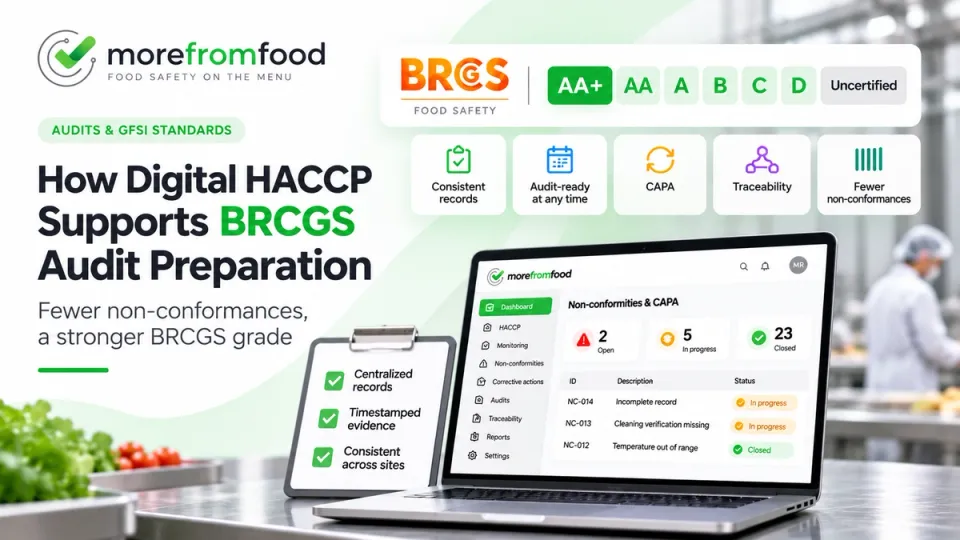
How Digital HACCP Supports BRCGS Audit Preparation
BRCGS doesn't just pass or fail a site — it grades it, from AA down to Uncertified, based directly on how many non-conformances are found and how severe they are. That grading structure is exactly why record quality has such a direct, visible effect on the outcome.
Digital HACCP supports BRCGS audit preparation by keeping records centralized, timestamped and consistently formatted, which directly reduces the kind of documentation-related non-conformances that move a grade from AA to A, or A to B. Because BRCGS also requires a portion of audits to be unannounced, the same records also need to hold up without advance notice, not just on a scheduled date.
Key takeaways
- BRCGS grades run from AA (highest) through C, then D and Uncertified, based on the number and severity of non-conformances — minor issues accumulate against your grade even when none are individually serious.
- At least one in three BRCGS audits must be unannounced within a defined window, and grades earned this way carry a "+" that many UK retailers specifically look for.
- After non-conformances are identified, sites typically have around 28 days to submit corrective action evidence before a final grade is confirmed.
- Digital records help most with the accumulation of minor findings, since these are usually documentation and consistency issues rather than genuine food safety failures.
- A higher grade isn't just a certificate — it affects audit frequency and commercial acceptance with retailers going forward.
In this article
- How does BRCGS grading actually work?
- Where do minor non-conformances usually come from?
- How digital records support a stronger grade
- Preparing for unannounced BRCGS audits
- What happens after non-conformances are found?
- FAQ
How does BRCGS grading actually work?
BRCGS assigns a letter grade based directly on the number and severity of non-conformances found during the audit: broadly, AA requires very few minor issues and no majors, A allows a modest number of minors, and grades drop further from there as minor and major findings accumulate, down to Uncertified if critical issues or a high volume of findings are present. Unannounced audits carry a "+" suffix (AA+, A+, and so on), which several UK retailers treat as a meaningful trust signal distinct from an announced result at the same letter grade.
Where do minor non-conformances usually come from?
In practice, a large share of minor BRCGS findings trace back to documentation rather than genuine food safety failures: a record that's incomplete, inconsistent between sites, hard to locate quickly, or missing a signature or timestamp. None of these necessarily reflect a real hazard — but each one still counts against the grade, and a handful of small documentation issues can be the difference between an AA and an A.
How digital records support a stronger grade
Digital HACCP addresses exactly this category of finding. Centralized, timestamped records remove the "can't locate it quickly" problem entirely. Consistent digital checklist formats across sites remove the "different site, different format" inconsistency that shows up when multiple locations rely on separately maintained paper or spreadsheets. Automatic verification (a required field that can't be skipped, a signature captured digitally) removes the missing-field category of finding before it can occur. None of this changes the underlying food safety practice — it removes the documentation-based findings that would otherwise chip away at an already-solid grade.
Preparing for unannounced BRCGS audits
Because at least one in three BRCGS audits must be unannounced, and because unannounced grades carry real commercial weight with UK retailers specifically, preparation can't be a pre-audit event — records need to already look audit-ready on any given day. This is where digital systems have a structural advantage: if checks are logged as they happen rather than compiled afterward, there's no distinction between "prepared" and "not yet prepared" for an auditor to catch.
What happens after non-conformances are found?
Once an audit identifies non-conformances, sites are typically given a defined window — commonly around 28 days — to submit documented corrective action evidence before the certification body finalizes the grade. A clear digital record of what was done, by whom, and when tends to support this stage more effectively than an email thread or a handwritten note, since it presents exactly the kind of evidence the reviewing certification body is looking for.
FAQ
Can digital records alone move a site from A to AA? Not by themselves — the underlying food safety practice has to be sound. What digital records reliably do is remove documentation-related findings, which is often exactly the gap between two adjacent grades.
Does BRCGS require specific software? No. BRCGS doesn't mandate a particular digital system — what matters is that records are complete, consistent, timestamped and retrievable, however that's achieved.
How much does an unannounced audit grade actually matter commercially? Several UK retailers specifically request or prefer suppliers with an unannounced-track grade, since it signals consistent food safety management rather than pre-audit readiness — it's increasingly treated as a de facto requirement in some supply chains.
What's the fastest way to check if we're likely to lose points on documentation alone? Run through recent records as if you were the auditor: are they complete, consistently formatted across sites, and locatable within a couple of minutes? Gaps here are usually the easiest wins available before an audit.
Related reading
- How to Prepare for a Food Safety Audit: Complete Guide
- How to Prepare for an IFS Audit Digitally
- IFS vs BRCGS vs FSSC 22000: What's the Difference?
See what your records would score under BRCGS grading
The clearest way to spot documentation gaps before an auditor does is to walk through your actual records with us directly.
Book a demo or email info@morefromfood.com.
