

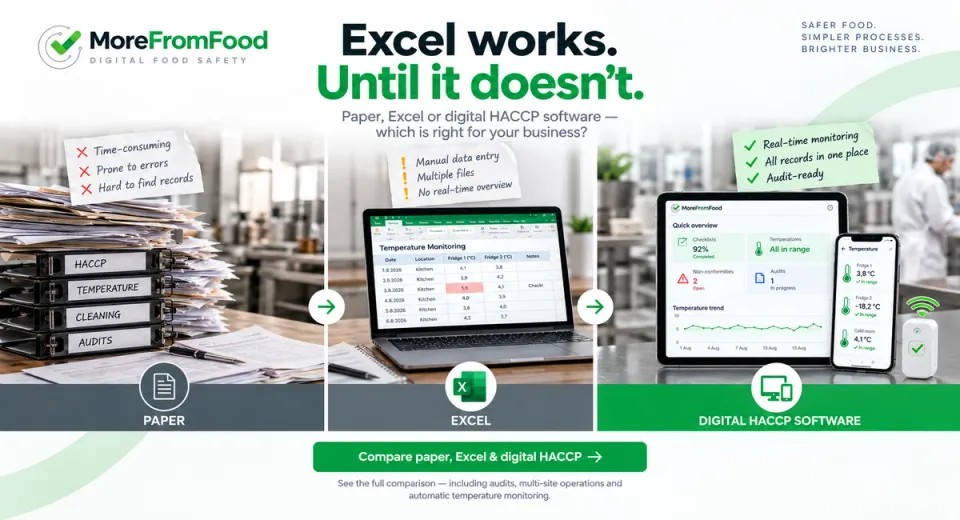
Paper vs Excel vs Digital HACCP Software: Which Is Best?
If your team already knows paper isn't ideal, the real question usually isn't whether to change — it's what to replace it with. Excel feels like the obvious middle step. But it comes with its own limits, and knowing where those limits sit is what actually determines whether Excel is enough, or whether it's time to move to dedicated digital HACCP software.
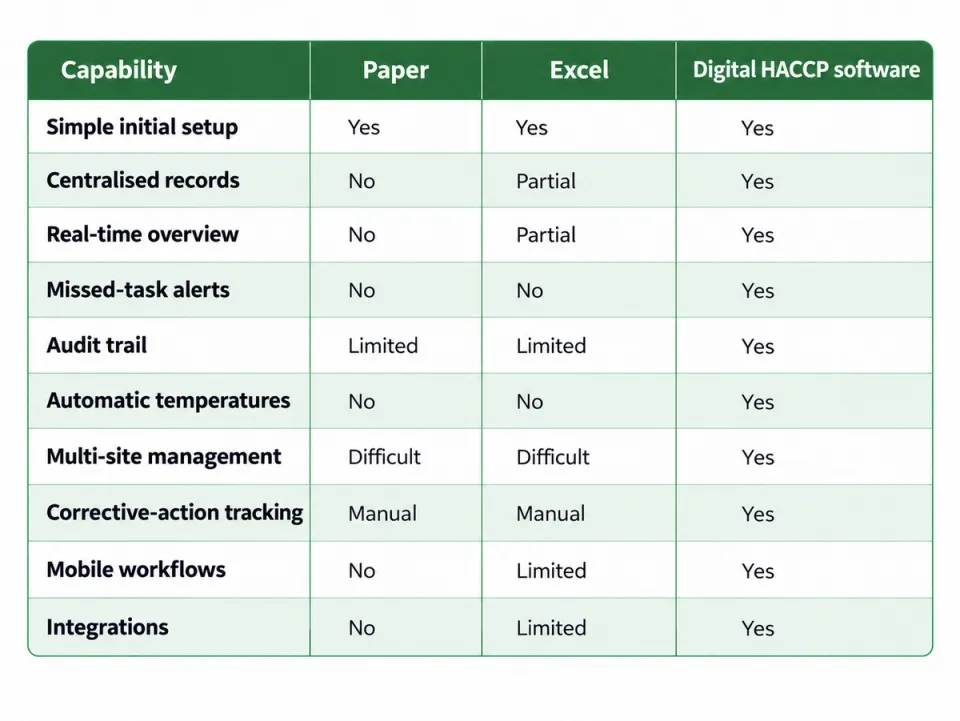
Paper, Excel and digital HACCP software all record the same underlying checks — but they differ in how reliably those records are captured, checked and retrieved. Paper depends entirely on manual completion and manual filing. Excel adds structure and calculation, but still depends on someone opening the right file and entering data correctly. Digital HACCP software captures data at the point of the check — manually or via sensors — and structures it automatically for review, alerts and audits.
Key takeaways
- Paper, Excel and digital HACCP software aren't three levels of the same tool — they solve different parts of the problem.
- Excel is a real, valid step up from paper, but it doesn't remove the two biggest paper risks: manual entry errors and no real-time overview.
- Research on operational spreadsheets has repeatedly found errors in the large majority of files reviewed — a structural risk, not a sign of careless staff.
- The clearest signals it's time to move beyond Excel are: multiple locations, frequent checks, upcoming audits, or a need for automatic temperature monitoring.
- The honest answer to "which is best" depends on the size and complexity of your operation — this article compares all three without assuming the answer.
In this article
- What is the difference between paper, Excel and HACCP software?
- How paper, Excel and digital HACCP software compare
- When is paper HACCP still enough?
- When does Excel become a problem?
- When should a business move to digital HACCP software?
- What are the hidden costs of paper HACCP?
- Paper vs digital HACCP for audits
- Paper vs digital HACCP for multi-site companies
- Paper vs digital HACCP for temperature monitoring
- Which option is best?
- FAQ
What is the difference between paper, Excel and HACCP software?
Paper HACCP means checks are recorded by hand on printed forms, stored physically, and reviewed manually. Excel-based HACCP means the same checks are typed into spreadsheets — usually one file per site, per month, or per process — which adds some structure and basic calculation, but still relies on someone manually opening, entering and consolidating data. Digital HACCP software captures the check at the point it happens, on a phone, tablet or via a sensor, and structures the record automatically: timestamped, attributed to a user, and immediately visible to whoever needs to see it.
The practical difference isn't "more digital is always better." It's what each approach can and can't do automatically — which is where the comparison below is more useful than a general impression.
How paper, Excel and digital HACCP software compare
When is paper HACCP still enough?
To be direct: for some businesses, it genuinely still is. A very small, simple food operation with a limited number of daily checks — a single small kitchen with one or two CCPs, for example — may operate adequately on paper, provided records are actually completed consistently and stored in a way that's retrievable during an inspection.
Paper's limits show up as volume and complexity increase: more checks, more staff completing them, more locations, or a growing need to prove compliance quickly during external audits. For a business well below that threshold, moving to software mainly saves time rather than solving a compliance risk.
When does Excel become a problem?
Excel becomes a problem exactly where its convenience runs out: multiple files, multiple contributors, and no built-in way to verify that a number was entered correctly or on time.
This isn't a hypothetical risk. Long-running academic research into operational spreadsheets — reviewing files actually used inside real organisations — has found that a large majority contain at least one error, often introduced during manual data entry, copy-paste operations or formula edits (Panko, spreadsheet error research, EuSpRIG). None of this means a team is careless with Excel — it reflects a structural limitation of manually maintained spreadsheets at scale, not a skills gap.
In a food safety context, that shows up as: a temperature logged in the wrong column, a formula that silently breaks after a row is inserted, or last month's file being edited instead of this month's. None of these are caught automatically — someone has to notice.
When should a business move to digital HACCP software?
There's no single trigger, but a few signals tend to show up together:
- You manage more than one location, and comparing records across sites means manually opening several files
- Checks happen frequently enough (multiple times a day, across multiple staff) that consolidating them by hand takes real time each week
- You're preparing for IFS, BRCGS or another external audit and it takes days to pull, print or organise the evidence
- You need temperature monitoring outside working hours — overnight, in unattended cold rooms — which paper and Excel cannot do
- Staff turnover means new employees need to be trained on where records live and how to fill them in correctly, repeatedly
If none of these apply yet, Excel (or even paper) may still be a reasonable fit. If two or more do, the time spent maintaining spreadsheets is usually already costing more than it appears to.
What are the hidden costs of paper HACCP?
The direct cost of paper — forms, binders, printing — is small. The hidden cost is staff time: time spent filling in forms, time spent re-entering paper data into a spreadsheet or report, time spent searching for a specific record, and time spent preparing binders before an audit. None of this shows up on an invoice, which is exactly why it's easy to underestimate.
Paper vs digital HACCP for audits
On paper, audit preparation usually means physically pulling records for the audit period, checking nothing is missing, and organising them into binders or folders — a process that can take days for a multi-site business. Digital HACCP software keeps records centrally and searchable from day one, so preparation becomes a matter of filtering by date and location rather than physically assembling documents. This also reduces a specific audit risk: a record that exists but genuinely cannot be found in time still counts as a missing record to an auditor. The same pattern shows up specifically in managing the audits themselves in Excel — scoring, scheduling and linking a finding to its resolution.
Paper vs digital HACCP for multi-site companies
A single site can often manage paper or Excel adequately, provided someone stays on top of it. Multi-site operations are where both approaches struggle structurally: there is no single view across locations without someone manually collecting and combining files from each site, and inconsistencies between how different sites fill in the same form are hard to catch until an audit or an incident forces a comparison. Digital systems handle this by design — every site logs into the same platform, so oversight doesn't depend on someone chasing files.
Paper vs digital HACCP for temperature monitoring
This is one of the clearest, most measurable differences. Manual temperature logging only captures a reading at the moment someone checks it — anything that happens between checks (a fridge door left open overnight, a freezer failure over a weekend) can go unrecorded and undetected until product is already affected. Automatic temperature monitoring with wireless sensors records continuously and can alert staff the moment a reading goes out of range, including outside working hours — something no paper or Excel-based process can replicate.
Which option is best?
There isn't a single correct answer that applies to every food business — the honest answer depends on your size, number of sites, and how much of your time is currently going into managing records rather than running the business. Paper can be adequate for a very small, simple operation. Excel is a reasonable middle step for a single site with a modest number of checks, as long as someone actively maintains data quality. Digital HACCP software earns its cost once you're managing multiple sites, need automatic temperature monitoring, or are spending real time each week consolidating and re-checking manually kept records.
FAQ
Is Excel enough for HACCP compliance? It can be, for a small operation with a low volume of checks and a disciplined process for maintaining it. It becomes harder to rely on as sites, staff and check volume grow, since nothing prevents an entry error or confirms a check happened on time.
Can I migrate from Excel to digital HACCP software without losing historical data? Historical spreadsheet data can typically be kept as an archive for reference, while new checks move into the digital system going forward. Most providers don't require re-entering years of past records to get started.
Does digital HACCP software replace the need for any manual checks? No. Digital HACCP software changes how a check is recorded and reviewed — the underlying check (a temperature reading, a hygiene inspection) is still carried out by a person, except where a sensor genuinely automates the measurement itself, such as continuous temperature monitoring.
Is paper HACCP illegal? No. EU food hygiene law requires a permanent, documented HACCP-based procedure — it doesn't mandate a specific format. Paper can meet that requirement in principle; in practice, it's harder to demonstrate consistently at scale. See our step-by-step guide to digitizing HACCP for more on the legal requirement itself.
How do I know if my business has outgrown Excel? If you're regularly spending time consolidating multiple files, chasing missing entries, or cross-checking numbers between sheets before an audit, that time is a signal worth taking seriously — even if the spreadsheet itself still "works."
Related reading
- How to Digitize HACCP: A Step-by-Step Guide — the 8-step process, and what changes (and doesn't) when you digitize
- How to Track Corrective Actions Digitally — the same paper/Excel disconnect shows up in linking a fix back to the original problem
- Digital HACCP Checklists
- Temperature Monitoring
- 6 Reasons Why Food Safety Is Better Managed With a Digital System
- Why Is It Important to Have All Your Data in Digital Forms?
- Next in this series: Best HACCP Software in 2026: Digital HACCP Systems Compared (publishing next)
Already decided to go digital?
If paper or Excel has reached its limit for your operation, the next step is knowing what to actually compare between providers — not just that you need one.
Next: How to choose HACCP software →
Or skip ahead and book a demo — every MoreFromFood setup starts with a conversation about your current HACCP plan and sites, not a self-serve signup.
