

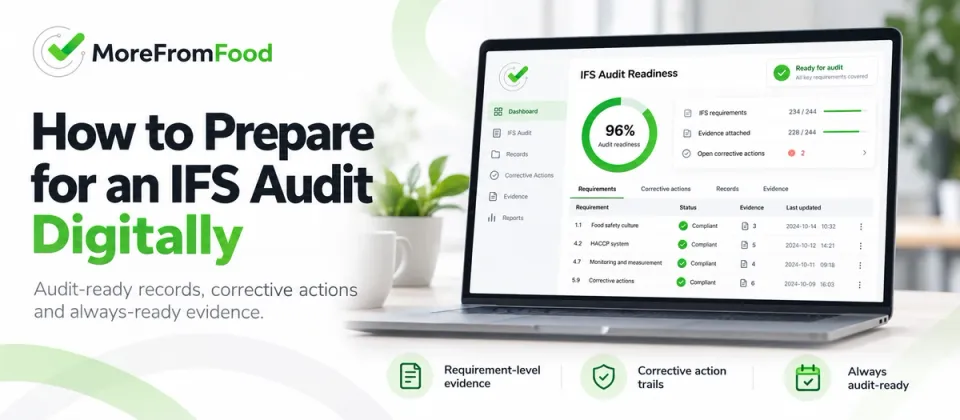
How to Prepare for an IFS Audit Digitally
IFS audits are known for one specific thing: a detailed, points-based scoring system that leaves less room for ambiguity than a simple pass/fail. That precision is exactly why the quality of your underlying records matters more here than in a looser audit format.
Preparing for an IFS audit digitally means making sure your records map cleanly onto IFS's specific requirements and can demonstrate, item by item, exactly what a scored audit is looking for — rather than general food safety documentation that requires interpretation. Digital systems help most with the parts of IFS that reward precision: consistent scoring evidence, clear corrective action trails, and records that hold up whether the audit is announced or not.
Key takeaways
- IFS uses a detailed points-based scoring system audited against specific requirements — vague or inconsistent records score worse than precise ones, even when the underlying practice is sound.
- At least one in three IFS audits must be unannounced, with certificates marked to reflect this — meaning records need to be audit-ready continuously, not just before a scheduled date.
- Digital checklists that mirror IFS's own structure make it easier to walk an auditor directly from a requirement to the evidence for it.
- Corrective action tracking matters specifically because IFS scores based on both the finding and how it was resolved.
- None of this changes what IFS requires — it changes how quickly and clearly you can demonstrate you're meeting it.
In this article
- What makes IFS audits different?
- How does IFS scoring actually work?
- Where do digital records help most for IFS?
- Preparing for unannounced IFS audits
- Common IFS-specific gaps
- FAQ
What makes IFS audits different?
IFS Food places explicit emphasis on both product and process as equally important audit subjects — it's not purely a documentation review, and not purely a physical inspection, but a structured combination of both, scored in detail rather than judged as an overall pass or fail. This structure rewards precision: an auditor working through a detailed scoring sheet needs to map each requirement to specific, locatable evidence, not a general sense that things are under control.
How does IFS scoring actually work?
IFS uses a points-based system where full compliance with a given requirement earns the maximum score (commonly referred to as an "A" result), with lower scores for partial compliance and specific deductions for different types of non-conformance. Because scoring happens at the level of individual requirements rather than an overall impression, the auditor needs to find specific evidence for each one — which is exactly where disorganized paper or scattered spreadsheets tend to cost businesses points even when the underlying food safety management is genuinely solid.
Where do digital records help most for IFS?
Three areas in particular tend to benefit from digital records in an IFS context:
- Requirement-by-requirement evidence. Digital checklists structured around your actual control points make it straightforward to pull up exactly the record a specific requirement calls for, rather than searching through general files.
- Corrective action trails. Because IFS scores consider how a non-conformance was resolved, not just whether one occurred, a clear digital record of the corrective action — who did what, and when — supports a better outcome than a note that a problem was "fixed."
- Consistency across time. Since audits are scored in detail, gaps in record consistency (a missing week, an inconsistent format) are more visible than they would be in a looser audit format — digital records that are structured the same way every time reduce this risk by default.
Preparing for unannounced IFS audits
At least one in three IFS audits must be unannounced, with the certificate itself marked to indicate this. In practice, this means the gap between "prepared for a scheduled audit" and "ready at any given moment" needs to be small. Digital records help here specifically because they don't require a pre-audit cleanup — if checks are being completed and logged as they happen, day to day, the system is effectively always in a demonstrable state, rather than needing preparation before a known date.
Common IFS-specific gaps
A few issues come up repeatedly in IFS audits specifically:
- Records that don't map clearly to a specific requirement, forcing the auditor to interpret rather than simply verify
- Corrective actions logged as complete without evidence of what was actually done
- Inconsistent record formats across sites or time periods, which stands out more under detailed, requirement-level scoring
- Gaps that only become visible under an unannounced audit, because records were being cleaned up before scheduled ones
FAQ
Does digital record-keeping change what IFS requires? No — the standard's requirements are the same regardless of format. What changes is how easily and precisely you can demonstrate compliance with each one during a scored audit.
How is IFS scoring different from BRCGS grading? IFS uses a detailed points system scored per requirement; BRCGS uses an overall letter grade (AA through C) based on the number and severity of non-conformances found. Both reward consistent, well-documented practice, but the mechanics differ — we cover this comparison in more detail separately.
Do we need IFS-specific software, or does general digital HACCP work? General digital HACCP software works well as long as it can structure checklists and records around your actual control points clearly enough to map to specific IFS requirements — it doesn't need to be IFS-branded specifically.
How much does an unannounced audit change our preparation approach? It shifts the goal from "preparing for a date" to "staying consistently ready" — which is really the underlying point of the unannounced audit format in the first place.
Related reading
- How to Prepare for a Food Safety Audit: Complete Guide
- How Digital HACCP Supports BRCGS Audit Preparation
- IFS vs BRCGS vs FSSC 22000: What's the Difference?
See how your records would hold up under IFS scoring
The clearest way to know if your records map cleanly to IFS requirements is to walk through them with us directly.
Book a demo or email info@morefromfood.com.
