

How Much Does HACCP Software Cost?
Search for HACCP software pricing and you'll mostly find "Contact us for a quote." That's not vendors being evasive — it's because the honest answer depends on variables that differ enormously from one food business to the next. This article won't give you a single number, because no accurate one exists, but it will explain the pricing models you'll actually encounter, what drives the cost regardless of model, and how to compare quotes fairly.
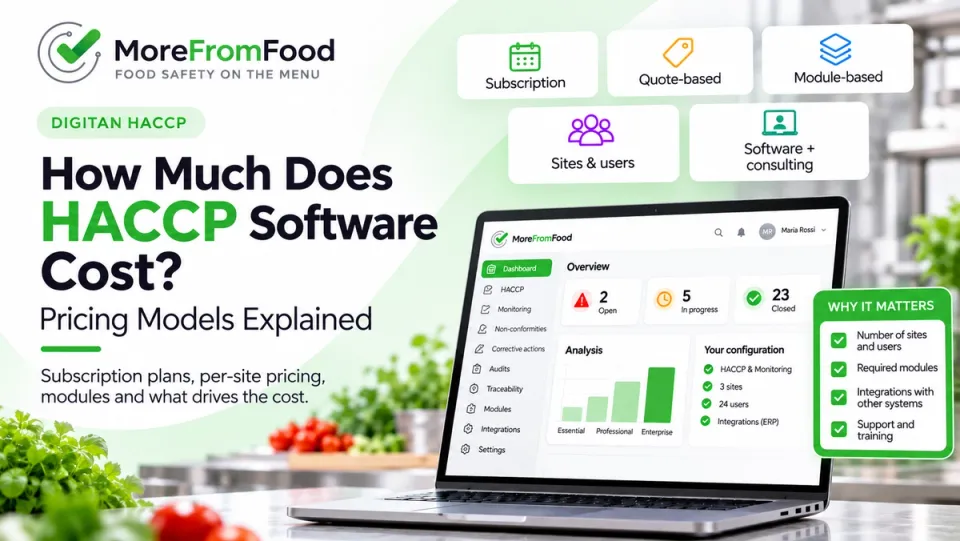
HACCP software is priced in one of four common ways — transparent subscription, quote-based per site, module-based, or bundled with consulting — and the actual cost within any of these depends on your number of sites, users, sensors and required integrations. Most platforms built for multi-site or manufacturing use don't publish pricing at all; smaller, self-service-oriented tools more often do.
Key takeaways
- There are four common pricing models in this market: transparent subscription, quote-based per site, module-based, and software-plus-consulting bundles.
- Quote-based pricing dominates for multi-site and manufacturing-grade platforms — this isn't unusual or a red flag, since cost genuinely varies too much for a flat rate to make sense.
- Regardless of model, the same handful of factors drive cost: number of sites, number of users, hardware/sensors, modules included, integrations and implementation support.
- Hardware (temperature sensors, gateways) and implementation/training are often priced separately from the core software subscription — budget for them explicitly.
- The fairest way to compare vendors is total cost at your actual scale over 2–3 years, not the "starting at" figure on a pricing page.
In this article
- Why is HACCP software pricing so hard to compare?
- The four common pricing models
- What actually drives the price, regardless of model?
- What extra costs should you budget for?
- Is free or low-cost HACCP software enough?
- How to compare pricing fairly across vendors
- FAQ
Why is HACCP software pricing so hard to compare?
Because "HACCP software" covers everything from a single-site checklist app to a multi-facility manufacturing platform with IoT sensors and ERP integration — and the cost difference between those two is enormous. A flat public price would either overcharge the simple use case or badly underprice the complex one, which is why most vendors serving multi-site or manufacturing businesses quote based on your specific setup rather than publishing a rate card.
The four common pricing models
1. Transparent subscription (published pricing) A fixed monthly or annual rate, often per user or per site, published directly on the vendor's website. This is more common among platforms built for smaller, single-site or small-chain businesses that want a self-service buying experience — you can see the price and sign up without a sales call.
2. Quote-based pricing (per site or per facility) No public rate card — pricing is scoped to your number of sites, users and modules through a sales conversation. This is the norm for platforms built for multi-site operations and food manufacturing, where the range between a small and large deployment is too wide for a single published number to be meaningful.
3. Module-based pricing The core platform is priced separately from add-on modules — automatic temperature monitoring, supplier management, traceability, audit management — so cost scales with which modules you actually need rather than a single all-inclusive tier.
4. Software plus consulting (bundled) Some vendors combine the software with hands-on consulting — building your HACCP plan, writing SOPs, preparing for audits — as part of the price. This suits businesses without in-house food safety expertise, but generally costs more than a software-only subscription, and can create more dependency on that vendor's consultants specifically.
What actually drives the price, regardless of model?
Whichever pricing model you're quoted under, the same factors move the number up or down:
- Number of sites — a single kitchen and a 12-site chain are different projects under any model
- Number of users — how many people need direct access to complete checks and view records
- Hardware and sensors — temperature monitoring hardware (probes, gateways, connectivity) is almost always priced separately from the software itself
- Modules included — checklists alone cost less than checklists plus monitoring plus audits plus traceability
- Integrations — connecting to an ERP, MES or BI platform typically adds cost, sometimes via a separate "enterprise" tier
- Implementation and support level — self-service setup costs less upfront than guided implementation with a dedicated onboarding team
- Contract length — monthly, annual or multi-year commitments often carry different effective rates
What extra costs should you budget for?
Beyond whatever the core subscription or quote covers, a few costs are easy to miss when comparing vendors:
- Hardware — temperature sensors and gateways are typically a separate line item, sometimes a one-time purchase, sometimes a recurring hardware-as-a-service fee
- Implementation/professional services — for multi-site rollouts, a one-time setup or configuration fee is common on top of the ongoing subscription
- Training — some vendors include this, others charge separately, especially for large or multi-language teams
- Add-on modules — features like supplier management or advanced traceability are sometimes bundled, sometimes billed as extras
For context, one industry pricing guide covering food safety software estimated transparent, self-service subscription plans in this space commonly fall somewhere in the $150–$500/month range — useful as a rough anchor for smaller, published-pricing tools, though it says little about what a multi-site, quote-based deployment would actually cost.
Is free or low-cost HACCP software enough?
For a very small, simple operation, it can be a reasonable starting point. Free or low-cost tiers typically cover basic checklists but often limit audit trail depth, traceability, multi-site management and offline capability — the criteria covered in our 15-feature HACCP software checklist. The real cost of an under-featured free tool tends to show up later: in the time spent working around its limits, or in a forced migration once the business outgrows it.
How to compare pricing fairly across vendors
- Ask for a quote at your actual scale, not the "starting at" number on the pricing page — a per-user rate designed for a 5-person kitchen doesn't tell you what a 50-person, 5-site rollout will cost.
- Ask what's included vs. billed separately — hardware, implementation, training and support tiers are the most common things left out of a headline number.
- Ask about contract length and cancellation terms — annual commitments are common in this space; know what you're signing before you compare a monthly number to an annual one.
- Compare total cost over 2–3 years, not month one — implementation and hardware costs are front-loaded, so a cheaper monthly rate with a large setup fee can cost more in year one than a pricier all-inclusive quote.
FAQ
Why don't most HACCP software vendors publish their pricing? Because cost varies too much by number of sites, users and modules for a single rate to be meaningful — this is standard in food safety compliance software, not unique to any one vendor.
Is quote-based pricing a red flag? Not on its own. It's the norm for platforms serving multi-site and manufacturing businesses specifically because their needs vary too widely for a flat rate. It's worth watching for is a vendor that won't give you a ballpark figure even after describing your setup in detail.
Does HACCP software pricing usually include hardware like temperature sensors? Generally no — sensors and gateways are typically priced as a separate line item from the software subscription, whether as a one-time purchase or a recurring fee.
Is it cheaper to buy software and consulting separately, rather than bundled? Often yes, if you have some in-house food safety expertise already, since you're only paying for consulting hours you actually need. Bundled options can be worth the premium if you're starting with little to no in-house expertise.
How do I know if a quote is reasonable for my size of business? Compare it against the total cost of ownership over 2–3 years, factoring in implementation and hardware, and check it against what paper-based food safety is currently costing you — our HACCP cost calculator is built for exactly that comparison.
Related reading
- Best HACCP Software in 2026: 5 Digital HACCP Systems Compared
- What Should HACCP Software Include? 15 Features to Compare
- Digital HACCP ROI: How Much Is Paper Really Costing You?
- Best HACCP Software for Food Manufacturing in 2026
- Digital HACCP for Supermarkets & Retail Chains — a good example of how scale and number of locations change what you actually pay for
Get a quote scoped to your actual operation
Rather than compare a generic starting price, get a quote based on your real number of sites, users and modules — every MoreFromFood conversation starts there, not with a self-serve price list.
Book a demo or email info@morefromfood.com.
