

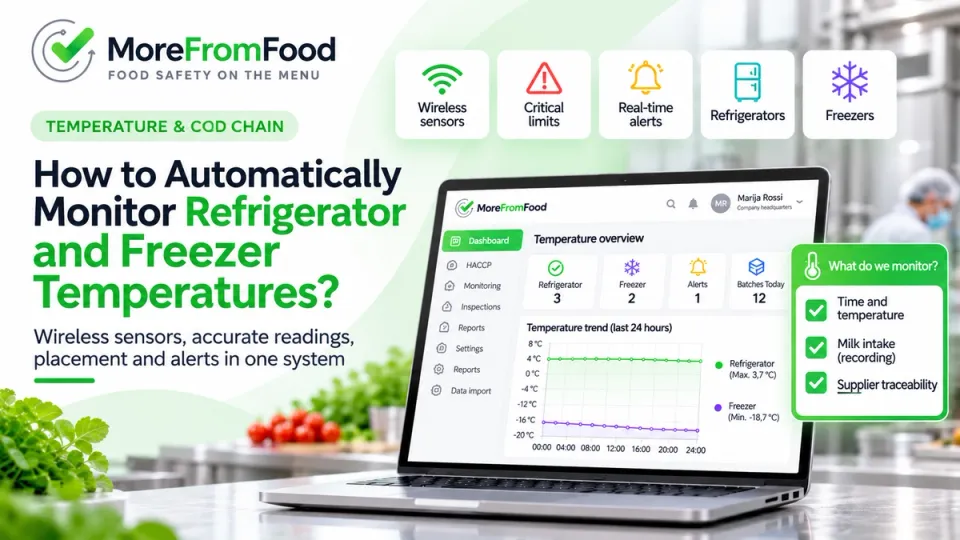
How to Monitor Refrigerator and Freezer Temperatures Automatically
Setting up automatic monitoring for a fridge or freezer is a smaller project than it sounds — the mechanism is the same for both, and most of the work is deciding thresholds and who gets alerted, not the technical setup itself.
Automatic monitoring for refrigerators and freezers works by placing a wireless sensor inside the unit, connecting it to a central system over Wi-Fi, setting a critical temperature limit, and configuring an alert for whenever a reading crosses that limit. The core process is nearly identical for both — the main differences are the target temperature itself and how you handle normal defrost cycles so they don't trigger false alarms.
Key takeaways
- The setup process is the same for fridges and freezers: sensor placement, Wi-Fi connection, threshold configuration, alert setup.
- Standard food safety guidance targets ≤4°C (40°F) for refrigerators and ≤-18°C (0°F) for freezers — but your own HACCP plan's critical limits take precedence if they differ.
- Freezers need one extra consideration fridges don't: scheduled defrost cycles cause temporary temperature spikes that shouldn't be treated as a deviation.
- Sensor placement matters — center of the unit, away from the door and evaporator, gives a more representative reading than a spot near an air vent.
- Automatic monitoring doesn't remove the need for periodic review — someone should still glance at the data regularly, not just wait for alerts.
In this article
- Why do fridge and freezer temperatures need monitoring?
- How to set up automatic monitoring, step by step
- Is a freezer monitored differently than a fridge?
- What should alert thresholds be set to?
- What happens when a unit goes out of range?
- How often should you review the data?
- FAQ
Why do fridge and freezer temperatures need monitoring?
Bacteria multiply fastest in what food safety authorities call the "danger zone" — roughly 4°C to 60°C (40°F to 140°F). Refrigeration keeps food below that zone; freezing effectively stops bacterial growth altogether. According to FDA guidance, refrigerators should be kept at or below 4°C (40°F) and freezers at or below -18°C (0°F). The purpose of monitoring isn't just compliance — it's catching the moment a unit drifts toward that danger zone before the food inside is affected.
How to set up automatic monitoring, step by step
1. Identify which units are critical control points. Not every appliance needs the same priority — start with units storing high-risk items (raw meat, dairy, ready-to-eat foods).
2. Choose sensor placement carefully. Center of the unit generally gives a more representative reading than a spot near the door or directly on an evaporator coil, which can show misleading extremes.
3. Connect the sensor to your system. Stationary sensors typically communicate over Wi-Fi to a cloud platform — this is usually the fastest step, often done by the vendor's team or your own staff.
4. Set the critical limit for that specific unit. This should reflect your HACCP plan's actual critical limits, which may be stricter than general guidance depending on what's stored inside.
5. Configure who gets alerted, and how. Assign a responsible person (or a small group with escalation) so an alert doesn't go to someone unavailable to act on it.
6. Verify against a calibrated reference thermometer. Before relying on the sensor fully, confirm its reading matches a trusted separate thermometer, and recalibrate periodically.
7. Review historical data periodically, not just when an alert fires — patterns (a unit that runs warm every afternoon, for example) are often visible in the data before they become an actual deviation.
Is a freezer monitored differently than a fridge?
The setup process is the same — the two real differences are the target temperature and defrost handling. Freezers need a lower critical limit (around -18°C/0°F vs. ≤4°C/40°F for fridges), and most freezers run scheduled defrost cycles that cause a temporary, expected temperature rise. A monitoring system that doesn't account for this can generate false alerts every time a defrost cycle runs — worth confirming with your provider how scheduled defrost periods are handled before you rely on alerts fully.
What should alert thresholds be set to?
As general orientation, ≤4°C (40°F) for refrigerators and ≤-18°C (0°F) for freezers are the standard FDA/USDA reference points, with 4–60°C (40–140°F) as the "danger zone" to stay out of entirely. That said, your own HACCP plan may specify different or more specific critical limits based on what's actually stored and your own hazard analysis — those figures should take precedence over general guidance whenever they differ.
What happens when a unit goes out of range?
The alert itself is only the first step. From there, the deviation should be logged as a non-conformance, a corrective action assigned (checking the door seal, moving product, calling a technician), and the outcome recorded — the same non-conformance and CAPA process covered in our broader HACCP digitization guide.
How often should you review the data?
Automatic monitoring reduces how often someone needs to physically check a unit, but it doesn't remove the value of periodically reviewing the data as a whole — a quick weekly look at trends can surface a unit that's drifting warmer over time, well before it crosses the alert threshold and becomes an actual deviation.
FAQ
Do I need a different type of sensor for a freezer than a fridge? Often yes — sensors need to be rated for the lower temperature range a freezer operates in. A sensor designed for standard refrigeration temperatures may not perform reliably at -18°C and below.
How long is food safe if a fridge goes out of range? As general guidance, a closed refrigerator typically keeps food safe for a few hours during a malfunction or outage; a full freezer can protect food substantially longer. Always confirm safe handling against your own HACCP plan and local food safety guidance rather than relying on this as a fixed rule.
Will defrost cycles trigger false alerts? They can, if the monitoring system isn't configured to account for them. Ask your provider specifically how scheduled defrost periods are handled before assuming every temperature spike will be treated as a genuine deviation.
Can one sensor monitor multiple units? Generally no — each unit needs its own sensor to give an accurate, unit-specific reading, though multiple sensors can report into the same central dashboard. If you're managing this across more than one site, see how to monitor refrigerators across multiple stores for what changes at that scale.
Do I still need a manual backup thermometer once automatic monitoring is in place? It's good practice to keep one for calibration checks and as a fallback during connectivity issues, even once automatic monitoring is your primary method.
Related reading
- Automatic Temperature Monitoring for HACCP: Complete Guide
- Manual vs Automatic Temperature Monitoring: Which Do You Need?
- How to Digitize HACCP: A Step-by-Step Guide
- Digital HACCP for Supermarkets & Retail Chains — refrigeration monitoring at the scale of an entire retail chain
- Temperature Monitoring (feature page)
Set this up on your own units
Every MoreFromFood setup starts with looking at your actual fridges, freezers and cold rooms directly, rather than a generic template — so thresholds and alerts are configured around what you actually store.
Book a demo or email info@morefromfood.com.
