

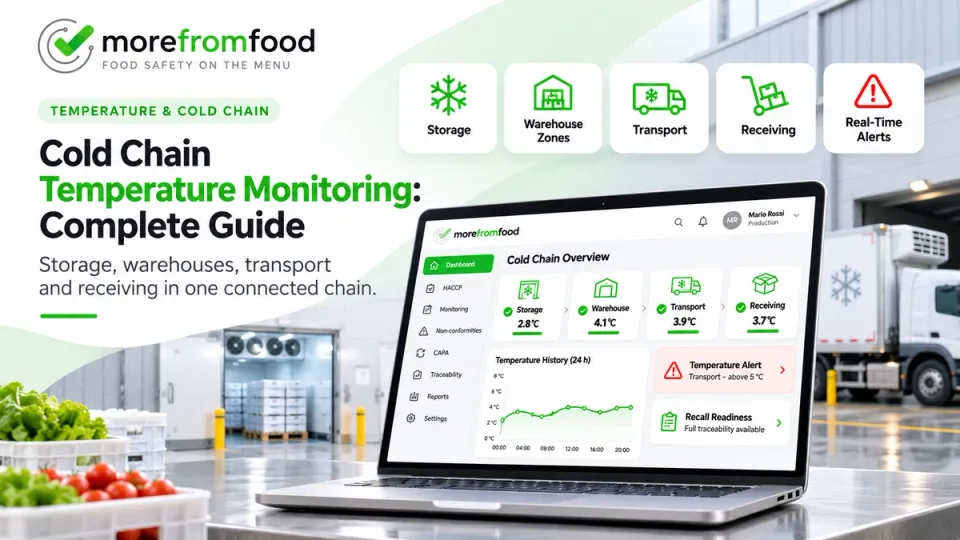
Cold Chain Temperature Monitoring: Complete Guide
The cold chain is only as strong as its weakest link — and that link is rarely the fridge everyone's watching. It's more often a loading dock, a delivery vehicle, or the twenty minutes between a truck arriving and someone actually putting the product away.
Cold chain temperature monitoring means tracking temperature continuously across every stage a product passes through — storage, warehousing, transport and receiving — rather than checking it at a single point and assuming the rest holds. A single well-monitored fridge doesn't protect a product that spent an hour on an unrefrigerated loading dock beforehand; the chain has to be unbroken end to end.
Key takeaways
- The cold chain includes every stage a temperature-sensitive product passes through: storage, warehousing, transport, and receiving at the next location.
- Most cold chain failures happen at transition points — loading docks, vehicle transfers, receiving — not inside the fridges and freezers themselves.
- Warehouses need zone-level monitoring, since temperature can vary meaningfully between different areas of the same large space.
- Transport monitoring typically combines temperature with location/time data, so a deviation can be tied to exactly where and when it happened.
- Continuous, chain-wide records support faster, more precise recall decisions than single-point checks ever could.
In this article
- What is the cold chain, and why monitor it end to end?
- Where does the cold chain actually break?
- Monitoring in warehouses
- Monitoring in transport and delivery
- Monitoring at receiving
- Why continuous monitoring beats single-point checks
- How does this support recall readiness?
- FAQ
What is the cold chain, and why monitor it end to end?
The cold chain is the unbroken sequence of temperature-controlled handling a product needs from production or storage through to its final destination — a warehouse, a retail location, or a kitchen. Monitoring it "end to end" means the goal isn't a well-controlled warehouse and a well-controlled truck treated as separate problems; it's making sure there's no gap between them where temperature control lapses unnoticed.
Where does the cold chain actually break?
Rarely inside a properly functioning fridge or freezer. The more common failure points are transitions: a pallet sitting on a loading dock before being loaded, a vehicle's refrigeration unit cycling off during a stop, or product sitting at a receiving dock before anyone gets to it. These moments are easy to miss with spot checks precisely because they're brief and happen between the points people are actively watching.
Monitoring in warehouses
A warehouse isn't a single temperature zone — different areas (near loading doors, high shelving, different aisles) can vary meaningfully depending on airflow and how often doors open nearby. Effective monitoring means sensors placed across multiple zones, not just one reading assumed to represent the whole space, with the same real-time alerting used for any other monitored location. Multi-tenant and logistics-specific warehouses add further requirements on top of this — see digital HACCP for warehouses and distribution for what changes at that scale.
Monitoring in transport and delivery
Vehicles introduce a variable storage doesn't have: constant movement and door openings at every stop. Transport monitoring commonly combines a temperature sensor with location and time data, so if a deviation occurs, it's tied to exactly where and when — useful both for identifying the cause (a stop that ran long, a unit that failed) and for documenting that a specific delivery stayed within range for the full journey. Catering operations rely on this same portable monitoring approach, since food there travels from kitchen to venue before it's ever served.
Monitoring at receiving
The moment a delivery arrives is a natural gap: product may sit at ambient temperature for a period between arrival and being moved into storage. A quick temperature check at receiving — ideally logged digitally and linked to that specific delivery — closes this gap and creates a clear record of the product's condition at handoff.
Why continuous monitoring beats single-point checks
A single check at receiving tells you the temperature at that moment — it says nothing about what happened during the preceding hours of transport. Continuous monitoring throughout the chain means a brief excursion during transit is visible in the data even if the product happens to read normally by the time it arrives, which matters because temperature abuse can affect food safety and shelf life even after the product returns to a safe temperature.
How does this support recall readiness?
In an actual recall situation, the question isn't just "was this product ever unsafe" — it's "which specific batches or shipments were affected, and can we prove which weren't." Continuous, chain-wide records make it possible to trace a specific batch's temperature history precisely, rather than treating an entire day's or week's production as potentially compromised because the record only shows a handful of spot checks.
FAQ
Does cold chain monitoring apply to small businesses, or only large logistics operations? The principle applies at any scale — even a single business receiving refrigerated deliveries benefits from checking and logging temperature at receiving, not just inside its own storage.
How is transport temperature typically monitored without a fixed power source? Portable, battery-powered sensors are commonly used in vehicles, syncing data either continuously (where connectivity allows) or once the vehicle returns to a location with a stable connection.
What's the difference between monitoring a warehouse and monitoring a single fridge? Scale and zoning — a warehouse needs sensors across multiple areas to catch localized variation, where a single fridge typically needs just one well-placed sensor.
How long should cold chain temperature records be kept? This depends on your products' shelf life and applicable regulation — as a general practice, records should be retrievable for at least the full shelf life of the product plus any additional period required by your specific food safety standard or local law.
Related reading
- Automatic Temperature Monitoring for HACCP: Complete Guide
- How Temperature Alerts Work in Digital HACCP
- How to Digitize HACCP: A Step-by-Step Guide
- Digital HACCP for Dairy Production — an industry where the cold chain starts before the product even reaches the plant
See your cold chain monitored end to end
Whether it's a single storage room or a multi-site distribution setup, every MoreFromFood configuration starts with mapping your actual chain — storage, transport and receiving — rather than a generic template.
Book a demo or email info@morefromfood.com.
