

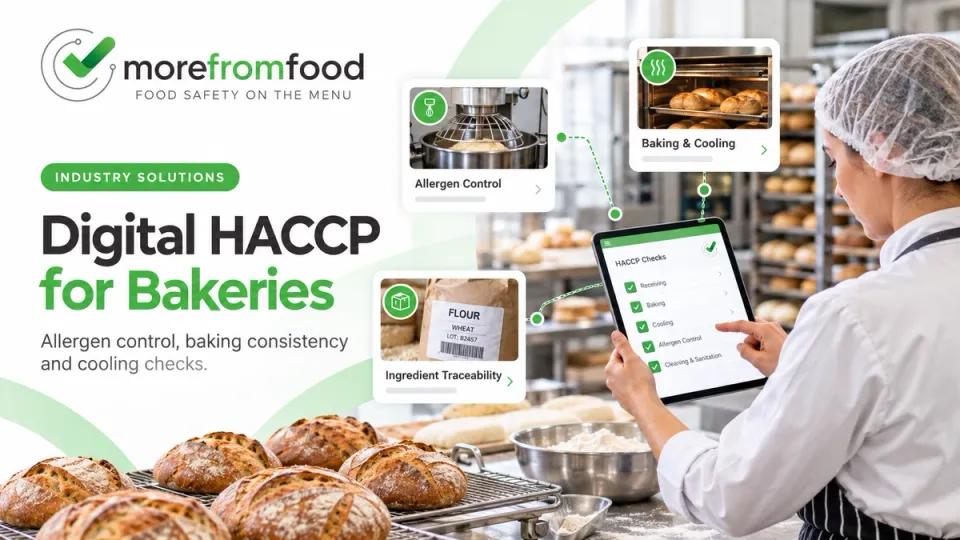
Digital HACCP for Bakeries
Bakeries don't usually have one dramatic kill-step the way dairy has pasteurization — baking itself gets most products to a safe temperature. The real risk concentration in bakery HACCP is elsewhere: allergen cross-contact, consistent process parameters across many small batches, and cooling before packaging.
Digital HACCP for bakeries means the same core system configured around bakery-specific risks: allergen control across shared equipment and lines, consistent monitoring of baking and cooling parameters, and checklists structured around high-frequency, small-batch production rather than a handful of large runs. The underlying platform is the same one used across food production more broadly — the configuration is what changes.
Key takeaways
- Allergen cross-contact is typically the highest-priority risk in a bakery producing multiple product lines on shared equipment.
- Baking itself often serves as the main kill-step, but cooling and post-bake handling introduce their own risk window before packaging.
- Bakeries often run many small batches rather than a few large ones, which makes checklist frequency and consistency more important than any single dramatic control point.
- Traceability in bakeries needs to account for shared ingredients (like a common flour or nut base) used across multiple different finished products.
- Digital checklists help most with consistency across a high volume of repeated, similar checks throughout the day.
In this article
- What's the main risk profile in bakery production?
- Managing allergen cross-contact
- Baking and cooling as control points
- Traceability across shared ingredients
- FAQ
What's the main risk profile in bakery production?
Compared to raw meat or dairy, most baked goods reach safe temperatures during baking itself, which shifts the primary food safety concern toward allergen management, ingredient handling, and what happens after baking — cooling, filling, decorating, and packaging — rather than a single hard microbiological kill-step to monitor.
Managing allergen cross-contact
Where a bakery produces multiple product lines — some containing nuts, gluten, dairy, or eggs, others not — cross-contact becomes the highest-priority control point. This typically means dedicated equipment or rigorous cleaning verification between allergen and allergen-free runs, with digital checklists confirming cleaning was actually completed and verified before a changeover, rather than assumed. A missed or incomplete cleaning verification here is exactly the kind of non-conformity that should trigger an immediate hold, not just a note for later.
Baking and cooling as control points
While baking itself often functions as the main thermal control, cooling introduces its own window of risk, particularly for products that will be filled, iced or handled further before packaging. Monitoring here is less about a single dramatic threshold and more about consistency: making sure cooling checks actually happen at the required frequency across a high volume of batches, which is exactly where a manual, paper-based process tends to lose consistency as batch volume increases.
Traceability across shared ingredients
Bakeries often use a small number of base ingredients (a shared flour, a shared filling) across many different finished products. If an issue is identified with one ingredient batch, traceability needs to identify every finished product line that used it — not just the one product where the issue was first noticed. This is the same kind of many-to-many batch relationship covered in our broader guide to traceability in food manufacturing, applied to a bakery's specific ingredient-sharing pattern.
FAQ
Is allergen management part of HACCP, or a separate system? It's commonly integrated into the same HACCP or food safety management system, since cross-contact is a genuine food safety hazard — treating it as a completely separate process usually just creates duplicate record-keeping.
Do small bakeries need the same level of digital control as large ones? The underlying principles apply at any scale, but a small single-site bakery may reasonably use a lighter setup than a multi-site or wholesale bakery producing at much higher volume — see our 15-feature checklist for weighing what actually matters for your scale.
How often should cooling checks be verified in a bakery? This depends on your specific HACCP plan and product risk, but the general principle is that checks need to happen frequently enough to catch a deviation before affected product moves to the next stage — digital reminders help ensure this happens consistently even during busy periods.
Can one digital system handle both allergen checklists and temperature monitoring? Yes — this is generally handled within the same platform rather than requiring separate tools, since both feed into the same overall food safety record.
Related reading
- How to Digitize HACCP: A Step-by-Step Guide
- How Digital Traceability Works in Food Manufacturing
- What Is a Non-Conformity in Food Safety? (And How Do You Manage One?)
See MoreFromFood configured for bakery production
Walk through your actual allergen controls, baking parameters and ingredient-sharing setup with us directly.
Book a demo or email info@morefromfood.com.
