

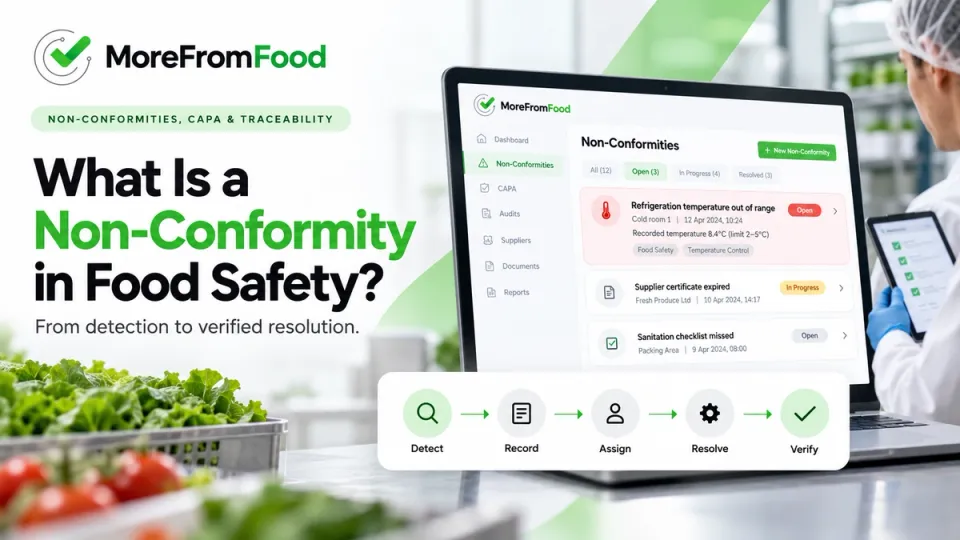
What Is a Non-Conformity in Food Safety? (And How Do You Manage One?)
Every food business has non-conformities — the question isn't whether they happen, it's whether you catch them quickly, record them properly, and actually close them out. A system with zero recorded non-conformities is usually a red flag to an auditor, not a sign of perfection.
A non-conformity in food safety is any deviation from your defined standard, procedure or specification — a temperature reading out of range, a missed check, a supplier document that doesn't meet requirements. Managing one well means detecting it, recording it with enough detail to act on, assigning it to someone responsible, and tracking it through to a documented, verified resolution — not just noting that something went wrong.
Key takeaways
- A non-conformity is any deviation from a standard or specification — it doesn't have to be a major incident to count.
- Non-conformities are typically classified by severity (minor, major, critical), and that classification determines how urgently and formally they need to be handled.
- The most common failure isn't missing non-conformities — it's recording them without a clear path to resolution.
- A healthy non-conformity process actually surfaces more issues over time, not fewer, because people trust that reporting one leads to a fix rather than blame.
- Digital systems help most with consistency: the same fields captured every time, and a clear link between a non-conformity and its resolution.
In this article
- What actually counts as a non-conformity?
- How are non-conformities classified?
- What does a complete non-conformity record include?
- How to manage a non-conformity, step by step
- Why "zero non-conformities" isn't actually a good sign
- How does this fit into a broader food safety system?
- FAQ
What actually counts as a non-conformity?
A non-conformity is any deviation from what your food safety plan, procedure or specification says should happen — it's a broad category by design. That includes an obvious food safety issue like a temperature reading outside a critical limit, but it also includes things like a checklist that wasn't completed on schedule, a supplier certificate that's expired, or a cleaning step that was skipped. Not every non-conformity represents an immediate food safety risk, but every one represents a gap between what should have happened and what did.
How are non-conformities classified?
Most food safety systems classify non-conformities by severity — commonly minor, major and critical, similar to the categories used in formal audits. A minor non-conformity might be a documentation gap with no direct safety impact; a major one might involve a process failure with real risk; a critical one typically involves an immediate, serious risk to food safety. This classification isn't just bureaucratic — it determines urgency, who needs to be involved, and how quickly a resolution is expected.
What does a complete non-conformity record include?
A useful non-conformity record answers several questions clearly: what happened, when it was discovered, who discovered it, how severe it is, who's responsible for resolving it, what corrective action was taken, and how it was verified as resolved. A record that only says "temperature was high, fixed" is missing most of what makes it useful later — both for your own tracking and for demonstrating a working system during an audit.
How to manage a non-conformity, step by step
1. Detect and record it as soon as it's noticed — not at the end of a shift or from memory later.
2. Classify its severity so the response is proportionate — not every non-conformity needs the same level of urgency.
3. Assign it to a specific responsible person, not a general team or department.
4. Investigate and address the immediate issue — the food, equipment or process problem in front of you right now.
5. Identify and address the underlying cause, not just the immediate symptom, where the non-conformity suggests a pattern rather than a one-off.
6. Verify the resolution actually worked, ideally with some evidence beyond a note saying it's done.
7. Close it out with a complete record — what happened, what was done, and confirmation it's resolved.
Why "zero non-conformities" isn't actually a good sign
A food safety system with no recorded non-conformities over a long period usually means one of two things: either issues genuinely aren't happening, which is rare at real operational scale, or they're happening and not being reported. Auditors generally read the second interpretation as more likely, since it suggests staff either don't feel comfortable reporting issues or aren't being asked to. A system that surfaces a steady, reasonable number of minor non-conformities — each one properly resolved — is usually a healthier signal than a suspiciously clean record.
How does this fit into a broader food safety system?
Non-conformity management connects directly to two other things covered elsewhere in this series: corrective and preventive action (CAPA), which is what actually resolves a non-conformity once it's identified, and audit preparation, since your non-conformity records are exactly what an auditor reviews to judge whether your system is genuinely working. We go deeper on the resolution side specifically in our guide to CAPA in food safety.
FAQ
Is a non-conformity the same as a food safety incident? Not necessarily — a non-conformity is any deviation from a standard, which may or may not represent an actual food safety risk. A missed signature on a form is a non-conformity; it's not the same severity as a genuine temperature abuse incident, even though both get logged the same way.
Who should be able to open a non-conformity? Generally, anyone who notices one — restricting reporting to certain roles tends to reduce how many genuine issues get caught early, since the people closest to daily operations often spot problems first.
Does every non-conformity need a formal corrective action? Most do, at least a brief one, even for minor issues — it's what distinguishes "we noticed and fixed something" from "we noticed something and moved on."
How long should non-conformity records be kept? This depends on your product's shelf life, jurisdiction and certification scheme — we cover this in more detail in How Long Should HACCP Records Be Kept?
Can digital systems help open non-conformities automatically? Yes — many digital HACCP systems can automatically flag a non-conformity when a check fails or a reading falls outside a defined limit, rather than relying on someone to notice and manually log it.
Related reading
- What Is CAPA in Food Safety? Corrective vs Preventive Action Explained
- How to Track Corrective Actions Digitally
- How to Prepare for a Food Safety Audit: Complete Guide
See non-conformity management in one connected system
From detection to a verified, documented resolution — see how MoreFromFood keeps the full non-conformity record connected.
Book a demo or email info@morefromfood.com.
