

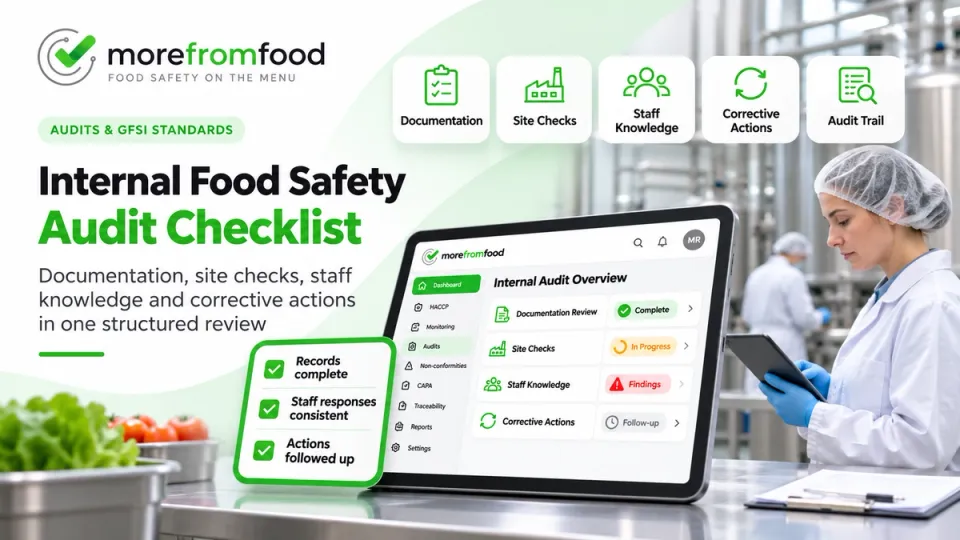
Internal Food Safety Audit Checklist
An internal audit only earns its keep if it's genuinely as critical as an external one would be. A self-check that quietly avoids the areas you suspect are weak defeats the purpose — the goal is to find gaps while you still have time to fix them, not to confirm what you already hoped was true.
An internal food safety audit checklist should cover the same core areas an external auditor would: documentation completeness, physical site conditions, staff knowledge, and the status of past corrective actions. Run regularly rather than only before a scheduled external audit, it becomes a genuine early-warning tool instead of a pre-audit scramble.
Key takeaways
- An internal audit is most useful when it's run with the same rigor as an external one, not as a lighter, friendlier version of it.
- Covering four areas — documentation, physical conditions, staff knowledge, and past corrective actions — mirrors what most external audits actually check.
- Frequency matters as much as content: an internal audit run only right before an external one mostly just documents existing gaps rather than giving time to fix them.
- Findings from internal audits should be tracked the same way external findings are — with an owner, a deadline, and evidence of resolution.
- A checklist that never finds anything is more likely under-scoped than genuinely spotless.
In this article
- What should an internal audit actually check?
- Documentation review
- Physical site checks
- Staff knowledge checks
- Reviewing past corrective actions
- How often should internal audits run?
- FAQ
What should an internal audit actually check?
The most useful internal audits are structured around the same four areas an external audit examines: whether your documentation is complete and consistent, whether physical conditions on-site match what your procedures describe, whether staff can answer food safety questions consistently, and whether corrective actions from previous findings were actually completed and sustained. Treating these as four distinct checks, rather than one general walkthrough, makes it much less likely that a weak area gets glossed over.
Documentation review
Pull a sample of recent records — checklists, temperature logs, corrective actions — and check them against the same five-part test an external auditor would effectively apply: complete, dated, attributable, consistently formatted, and retrievable within a few minutes. Missing signatures, blank fields, or records that took too long to locate are the most common and most fixable findings at this stage.
Physical site checks
Walk the site the way an outside auditor would, not the way someone familiar with it every day would. Check that physical conditions genuinely match what's documented — storage temperatures, hygiene stations, equipment condition, labeling — rather than assuming they do because nothing's been flagged recently. Familiarity is exactly what makes small physical gaps easy to miss internally.
Staff knowledge checks
Ask staff the same direct questions an external auditor would: what do you do if a reading is out of range, where do you record it, who do you notify. Inconsistent answers between staff members are a genuine finding in their own right, even when the written procedure is correct — it signals a training or communication gap rather than a documentation one.
Reviewing past corrective actions
An internal audit should specifically check whether previous corrective actions were not just marked complete, but actually sustained. A recurring issue that keeps getting "resolved" the same way each time usually indicates the underlying cause was never actually addressed — which is exactly the kind of pattern an external auditor is likely to notice on a renewal audit.
How often should internal audits run?
Internal audits are most valuable when they're routine rather than tied only to an upcoming external audit — quarterly is a common cadence for many food businesses, though the right frequency depends on your risk level and audit schedule. An internal audit run only in the days before an external one mostly documents existing gaps without leaving time to genuinely fix them, which defeats much of the purpose.
FAQ
Should the same person always run the internal audit? Rotating who conducts it, or bringing in someone from a different site or department, tends to catch more than the same person checking the same areas every time, since familiarity is often what causes gaps to go unnoticed.
What's the point of an internal audit if we're not being graded on it? The value is entirely in finding and fixing gaps with time to spare, before an external auditor — who is scoring you — finds them instead.
Should internal audit findings be tracked the same way as external ones? Yes — an internal finding without an assigned owner, deadline, and documented resolution is just as likely to be forgotten as an external one, and defeats the purpose of running the audit in the first place.
Is a checklist that finds nothing a good sign? Not necessarily — it's often a sign the checklist isn't probing deeply enough, rather than genuine evidence that everything is perfect. A well-designed internal audit should surface at least minor issues periodically.
Can digital tools make internal audits easier to run consistently? Yes — a digital checklist structured the same way each time removes the temptation to skip sections, and automatically creates a record of when the audit was run and what it found, which is useful evidence in its own right.
Related reading
- How to Prepare for a Food Safety Audit: Complete Guide
- What Makes Food Safety Records Audit-Ready?
- How to Track Corrective Actions After an Audit
Run your internal audits digitally
Structure your internal audits the same way each time, and keep a clear record of findings and follow-up.
Book a demo or email info@morefromfood.com.
